Best Microchip Cat Feeder (2026 Guide) – RFID vs Smart Feeders Compared
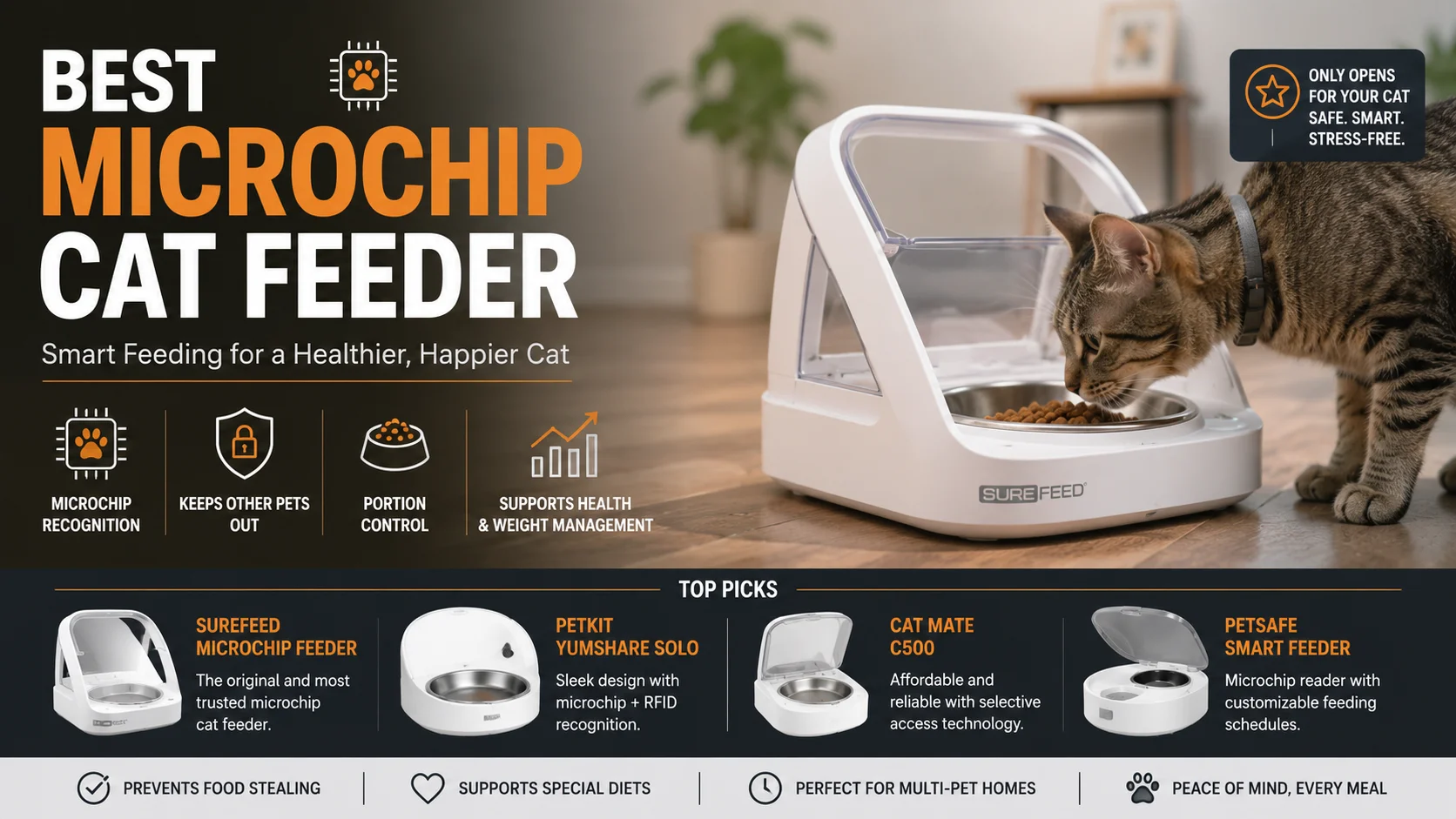
If mealtime at your house turns into a wrestling match over who eats what, you already know the frustration of food stealing in a multi-cat home. One cat finishes her bowl in seconds, then muscles into her sibling’s dish, and soon one cat is overweight while the other goes hungry.
This is exactly the problem the best microchip cat feeder is built to solve. Unlike a regular bowl, a microchip-controlled feeder only opens for the pet it recognizes, which means no more sneaky snacking and no more diet sabotage.
In this guide, we’re comparing three of the most talked-about options on the market right now: the SureFeed Microchip Pet Feeder MPF001, the SureFeed Connect, and the PETLIBRO RFID Automatic Cat Feeder. We’ll look at how each performs with wet food, multiple cats, and everyday real-world use, so you can choose the best RFID cat feeder or microchip model for your household without the guesswork.
By the end, you’ll know exactly which feeder fits your cats’ needs, your budget, and your comfort with apps and tech. Think of this as a hands-on set of microchip cat feeder reviews built around one goal: helping you pick an automatic microchip cat feeder that actually stops food stealing.
What is a Microchip Cat Feeder?
A microchip cat feeder is an automatic feeder that reads your cat’s existing identification microchip, or a lightweight RFID collar tag, and only unlocks the lid for that specific pet. Other cats, or a nosy dog, simply can’t get the lid to open.
Most cats already have an ID microchip implanted by their vet for identification purposes. An automatic microchip cat feeder reuses that same chip as a digital key, so there’s nothing extra to attach to your cat unless you’d rather use a collar tag instead.
This setup matters most in multi-cat homes with a known food thief, households managing prescription or weight-loss diets, and any home where portion control affects a cat’s health. Because the feeder only responds to its registered pet, every cat eats its own food, at its own pace.
RFID vs Microchip Cat Feeder Difference
People often use “RFID” and “microchip” as if they’re the same thing, but there’s a real difference between an RFID cat feeder vs microchip feeder when you look closely.
A true microchip feeder, like the SureFeed models, reads the implant your vet already placed under your cat’s skin. There’s nothing to charge, clip on, or lose. An RFID feeder, like PETLIBRO’s, instead relies on a small tag worn on a collar. It works well, but only for as long as the cat keeps that collar on.
| Feature | Microchip Feeder | RFID Collar Feeder |
|---|---|---|
| Recognition method | Existing implanted ID chip | External collar tag |
| Risk of losing the “key” | None, it’s already implanted | Tag can fall off or be removed |
| Setup process | Scan the chip once, done | Attach and pair a collar tag |
| Comfort for the cat | Nothing extra worn | Lightweight collar required |
| Typical example | SureFeed MPF001, SureFeed Connect | PETLIBRO RFID feeder |
Both approaches solve food stealing effectively. However, if your cat hates wearing anything around its neck, a true microchip system has a clear edge. If app convenience and price matter more than the chip-vs-collar debate, the PETLIBRO is generally considered the best RFID cat feeder, while SureFeed’s lineup remains the benchmark for a true automatic microchip cat feeder.
Best Microchip Cat Feeder (Top 3 Reviews)
We compared specs, verified buyer ratings, and real purchase volume to put together honest microchip cat feeder reviews for the three most popular models on Amazon right now.
SureFeed MPF001 Review


The SureFeed Microchip Pet Feeder MPF001 is the no-frills original, and it carries a 4.3 out of 5 rating from more than 13,000 buyers. It doesn’t need an app or a hub. You scan your cat’s chip once, and the feeder remembers it from then on.
It’s compatible with 9-digit (Avid Secure), 10-digit (FDXA), and 15-digit (FDXB) microchip formats, which covers the vast majority of cats. If your cat isn’t chipped, it ships with one RFID collar tag instead, and the unit can store up to 32 separate pet IDs, which is plenty even for a large multi-cat household.
Wet food performance: The bowl holds 13.5 fl. oz. and closes with a neoprene seal that locks in moisture, so wet food stays fresh instead of crusting over between meals.
Reliability for multi-cat homes: Because the lid opens only when the assigned chip is detected and shuts the moment the cat walks away, it’s genuinely effective at stopping one cat from raiding another’s bowl.
Pros: no app or WiFi setup required, three-year warranty, vet-recommended status, and full wet-and-dry food compatibility.
Cons: no remote monitoring or portion history, and the one-button programming feels basic if you’re used to smart-home gadgets. Because the MPF001 also ships with an RFID collar tag option, some shoppers searching for the best RFID cat feeder land here too, even though its core technology is microchip-based.
SureFeed Connect Review


The SureFeed Connect uses the same microchip-based locking mechanism as the MPF001, then layers smart monitoring on top. It holds a 4.2 out of 5 rating from over 900 reviewers.
Here’s the catch: the full smart experience only unlocks once you add the separately sold Sure Petcare Hub. Once paired, the Connect tracks portions within 1 gram of accuracy, using built-in scales and LED guides to help you measure exact servings, which is useful for catching appetite changes early.
Smart features include app-based feeding logs through the Sure Petcare app, so you can see exactly how much and how often your cat is eating from your phone.
This is really the deciding factor in SureFeed Connect vs MPF001: if you need to track portions for a prescription diet or a weight-loss plan, the Connect’s scale and history log earn their higher price. If you just want reliable selective feeding, the MPF001 does the same core job for less.
Pros: detailed feeding history, weight-change alerts, the same dependable microchip and RFID recognition as the MPF001, and full wet food compatibility with its moisture-sealing lid.
Cons: the hub is sold separately, which adds to the total cost, and the price jump over the MPF001 is hard to justify if you don’t actually need the data logging. As an automatic microchip cat feeder with full app support, the Connect is built for anyone who wants data, not just selective feeding, and in most microchip cat feeder reviews it scores highest for households juggling prescription diets.
PETLIBRO RFID Cat Feeder Review


The PETLIBRO RFID Automatic Cat Feeder takes a different, budget-friendly route. Instead of reading an implanted microchip, it identifies each cat through a small RFID tag worn on a collar. It holds an impressive 4.2 out of 5 rating across more than 19,000 buyers, making it one of the best-selling smart feeders in its category.
As a budget smart feeder, it costs noticeably less than either SureFeed model while still offering full app control. Each cat wears its own collar tag, and the feeder’s lid opens only for the matching tag, which is handy for managing different diets across multiple pets.
Its app and WiFi features include dual-band connectivity (2.4GHz and 5GHz) for scheduling, low-food alerts, and eating-habit tracking, plus a battery backup that keeps the feeder running through power or WiFi outages.
One important note: this is a dry-food-only feeder with a 3-liter hopper, roughly enough kibble for one cat for two weeks. It isn’t built for wet meals the way the SureFeed models are.
Pros: the most affordable of the three, strong app functionality, battery backup for outages, and a massive review base that proves real-world popularity.
Cons: dry food only, and the collar tag can be lost, knocked off, or chewed loose by a determined cat. For shoppers specifically hunting for the best RFID cat feeder rather than a microchip system, PETLIBRO is usually the top recommendation, and it shows up in nearly every roundup of microchip cat feeder reviews thanks to its price and feature set.
Comparison Table
This snapshot sums up everything from our microchip cat feeder reviews above, useful whether you want the best microchip cat feeder for multiple cats or a single fussy eater.
| Feeder | Technology Type | App Support | Wet Food Support | Reliability | Price | Best Use Case |
|---|---|---|---|---|---|---|
| SureFeed MPF001 | Microchip + RFID collar | Not needed | Yes | Very high, no syncing required | $169.99 | Simple, reliable multi-cat homes |
| SureFeed Connect | Microchip + RFID collar | Yes, requires Hub | Yes | High once hub is paired | $227.90 | Diet tracking, prescription diets |
| PETLIBRO RFID | RFID collar tag only | Yes, built-in WiFi | No, dry food only | Good, depends on collar staying on | $139.99 | Budget multi-pet, dry food households |
Best Microchip Cat Feeder for Multiple Cats
Anyone raising more than one cat already knows how chaotic feeding time can get. One cat eats too fast, another grazes all day, and a third decides every bowl in the room belongs to her.
This is exactly where the best microchip cat feeder for multiple cats earns its keep. Because the feeder is tied to one pet’s chip or tag, it physically cannot open for the wrong cat, no matter how persistent that cat is.
For an automatic feeder for multi cat household use, the SureFeed MPF001 is the easiest entry point since it needs zero setup beyond scanning each chip. An automatic microchip cat feeder built for multi-cat households should never require manual supervision once it’s set up correctly. Households juggling prescription diets across several cats tend to prefer the SureFeed Connect for its tracking, while budget-conscious multi-pet homes lean toward PETLIBRO if wet food isn’t part of the routine.
SureFeed Connect vs MPF001
These two feeders share the same microchip-reading core, so the real decision comes down to whether you need data.
The MPF001 is the better pick if you want something that simply works, with no app, no hub, and no subscription-style ecosystem to maintain. It’s also slightly cheaper and just as reliable at stopping food theft.
The Connect makes more sense if a vet has asked you to monitor a cat’s eating patterns, or if you’re managing weight loss and want hard numbers instead of guesswork. The 1-gram scale accuracy and feeding-history logs are genuinely useful for that purpose, and the hub investment pays off over time for households with health-sensitive cats.
In short: choose MPF001 for simplicity, choose Connect for data and diet monitoring.
PETLIBRO vs SureFeed Comparison
The biggest difference here isn’t brand loyalty, it’s technology. PETLIBRO relies entirely on an RFID collar tag, while both SureFeed models can read an implanted microchip directly.
That distinction matters for security: a microchip can’t be lost, while a collar tag can slip off during play, momentarily leaving a cat without its “key.” PETLIBRO, however, wins clearly on affordability and ships with a more modern WiFi app experience right out of the box.
If wet food is part of your cats’ diet, that alone may settle the decision, since PETLIBRO is dry-food-only while both SureFeed units handle wet meals. For dry-food-only, budget-focused multi-pet homes, PETLIBRO remains a strong value pick and, for many shoppers, the best RFID cat feeder available right now.
Best Cat Feeder for Food Stealing Cats
Food stealing usually isn’t bad behavior, it’s instinct. Cats are opportunistic eaters, and a faster or bolder cat will always test whether an open bowl is fair game.
This is why selective feeding matters so much more than simply “feeding cats separately.” A microchip or RFID feeder physically blocks access rather than relying on timing or supervision, which is the only approach that reliably stops a determined food thief.
In real multi-cat households, the best cat feeder for food stealing cats is whichever model matches the thief’s personality. A food thief that tolerates a collar does fine with PETLIBRO or a SureFeed RFID tag. A more food-driven, collar-hating cat is better served by a true microchip feeder like the MPF001 or Connect, since there’s no tag for them to lose or rub off.
Real User Problems (What Owners Actually Report)
No feeder is flawless, and real owner feedback gathered across dozens of microchip cat feeder reviews consistently points to a handful of recurring issues worth knowing before you buy.
Microchip detection delay: Some owners report a brief one-to-two-second pause between a cat approaching and the lid unlocking, especially if the chip isn’t centered near the sensor.
RFID collar loss problem: Collar-based systems like PETLIBRO depend on the tag staying attached, and active or multi-cat households occasionally lose tags during play.
WiFi and app connectivity issues: Smart feeders that rely on home WiFi can briefly disconnect during router resets or firmware updates, delaying remote alerts until the connection returns.
Wet food drying problems: Even with a sealing lid, wet food left out too long in a warm room can dry out faster than expected, so feeding schedules still matter.
Multi-cat confusion issues: In larger households, owners occasionally need to reprogram a feeder after a chip fails to register correctly, particularly with older or fainter microchips.
None of these issues are dealbreakers, but knowing about them upfront helps set realistic expectations.
Are Microchip Cat Feeders Worth It?
On price alone, a microchip feeder costs more than a basic timed feeder. However, the cost comparison looks different once you factor in wasted prescription food, vet visits tied to weight problems, and the stress multiple cats experience during contested mealtimes.
From a vet recommended cat feeder standpoint, selective feeding is frequently suggested for households managing one overweight and one underweight cat, since portion control is one of the most effective, low-stress interventions available.
So, are microchip cat feeders worth it? For single-cat homes with no competition at mealtime, probably not necessary. For any home with more than one cat, or a cat on a special diet, the answer is almost always yes. The upfront cost is recovered quickly in saved food, fewer health complications, and noticeably calmer feeding routines.
Buying Guide
Wet food vs dry food feeders: If your cats eat wet food, prioritize a sealing lid like the SureFeed models offer. Dry-food-only households have more flexibility, including budget options like PETLIBRO.
Multi-cat vs single-cat homes: Selective feeding only matters once there’s competition. Single-cat households can usually skip microchip technology entirely and save the money, while anyone shopping for the best microchip cat feeder for multiple cats should prioritize chip storage capacity, like the MPF001’s 32-ID memory.
Budget vs premium options: PETLIBRO is the clear budget pick and arguably the best RFID cat feeder for cost-conscious, multi-pet homes. The MPF001 sits in the middle, and the Connect is the premium choice once you add hub and app functionality.
Smart vs basic feeders: Whether you pick a basic or smart automatic microchip cat feeder, the underlying chip-reading technology works the same way. Choose a basic feeder, the MPF001, if you just want reliable selective feeding. Choose a smart feeder, the Connect or PETLIBRO, if remote monitoring and feeding history genuinely matter to your routine.
READ ARTICLE ON BEST AUTOMATIC CAT FEEDERS
What is the best smart cat feeder in 2026?
Among current options covered in our microchip cat feeder reviews, the SureFeed Connect leads for health-tracking households, while PETLIBRO remains the top pick for budget-friendly smart features with full app and WiFi support.
What’s the RFID vs microchip feeder difference?
A microchip feeder reads your cat’s existing implanted ID chip, while an RFID feeder relies on an external collar tag. Microchip systems can’t be lost; collar tags occasionally can.
Is there a good wet food automatic cat feeder?
Yes. Both the SureFeed MPF001 and SureFeed Connect use a neoprene-sealed lid designed specifically to keep wet food fresh between scheduled meals.
What’s the best automatic feeder for a multi cat household?
Any true microchip or RFID feeder works, but households with several cats and complex diets typically prefer the SureFeed Connect for its individual feeding history per pet.
Are microchip cat feeders worth it?
For multi-cat homes or cats on special diets, yes. The cost is usually offset by reduced food waste, fewer diet-related vet visits, and calmer mealtimes overall.
Do I need an app to use a microchip cat feeder?
No. The SureFeed MPF001 is a fully automatic microchip cat feeder that works without an app or hub. Apps are only required for the data-tracking features on the SureFeed Connect and PETLIBRO models.
1 Comment
[…] Read Article on : Best Microchip Cat Feeder […]