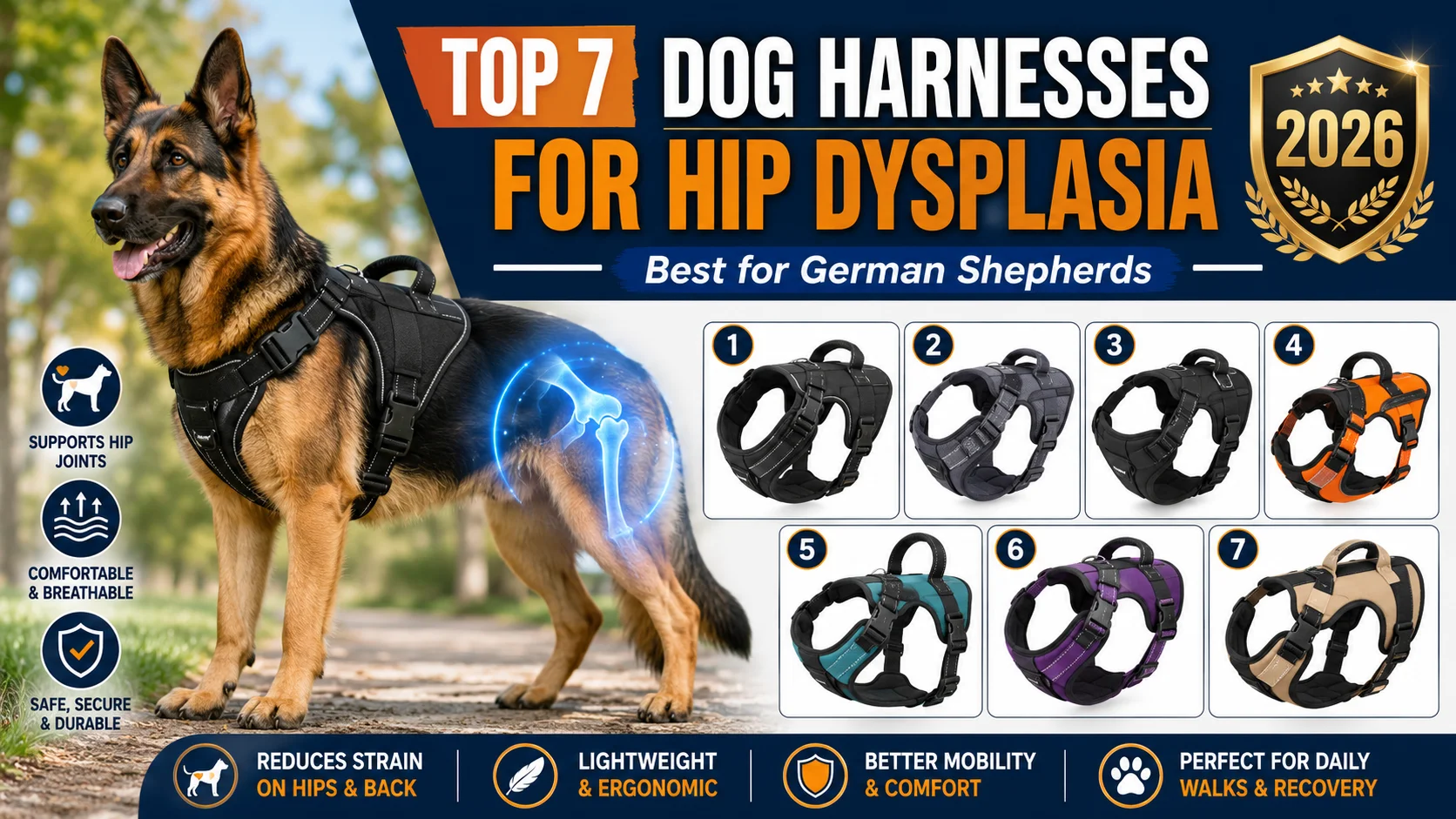
Best Dog Harness for Hip Dysplasia: Top 5 Picks for German Shepherds (2026)
📑 TABLE OF CONTENTS
- Why Hip Dysplasia in German Shepherds Needs Special Attention
- What to Look for in a Harness — Buying Guide
- Best Dog Harness for Hip Dysplasia — Our Top 5
- How We Tested These Products
- Frequently Asked Questions
- Final Verdict
INTRO
Watching your German Shepherd struggle to stand up from the floor is one of the hardest things as a dog owner. We’ve lived it with Max, our 7-year-old GSD, ever since his bilateral hip dysplasia diagnosis eighteen months ago. The very first thing our vet told us — before medication, before supplements, before anything else — was: “He needs a proper support harness for dogs.”
Finding the right best dog harness for hip dysplasia, though? That took us three weeks of testing, two returns, and a lot of input from Max’s canine rehabilitation therapist. A proper German Shepherd harness specifically built for mobility support is not the same as a regular walking harness — and most pet owners don’t realize that until they’ve already wasted money on the wrong product.
In this guide, we’re sharing exactly what worked — built on real hands-on experience and backed by veterinary research. Whether your dog’s condition is in the early stages or involves serious mobility loss, you’ll know exactly which dog harness for bad hips to buy by the time you finish reading.
Why German Shepherd Hip Dysplasia Needs Special Attention
German Shepherd hip dysplasia isn’t rare. It’s practically expected in the breed.
According to the Orthopedic Foundation for Animals (OFA), 20.6% of German Shepherds — roughly 1 in 5 — were found to have hip dysplasia based on 138,902 evaluations through December 2022. That makes it one of the most prevalent health conditions in the breed, and one of the primary reasons GSDs often need a support harness for dogs as they age.
The condition itself is a developmental problem. In German Shepherd hip dysplasia, the ball of the femur doesn’t fit properly into the hip socket, causing the joint surfaces to grind against each other instead of moving smoothly. Over time, that friction breaks down cartilage, causes chronic inflammation, and leads to secondary osteoarthritis. As published research in veterinary rehabilitation journals confirms, joint laxity leads to subluxation, which in turn drives abnormal development of the femoral head and acetabulum — causing excessive cartilage wear and, ultimately, osteoarthritis.
You’ll see it in your dog before you get the X-ray results. Hesitation on stairs. Slow, stiff movement after rest. Weight shifted oddly onto the front legs. A reluctance to jump that wasn’t there a year ago. Dog back leg weakness is often the most visible early sign owners notice during daily walks — and once you recognize dog back leg weakness in your GSD, it’s time to start researching proper support options.
Here’s why a regular collar or standard German Shepherd harness doesn’t work for this condition: dogs with dog back leg weakness need rear-specific support that redistributes weight away from the compromised joint. A purpose-built orthopedic dog harness does exactly that — it gives your dog lift assistance from underneath, reduces the strain on the hip joint during movement, and gives you a safe, controlled way to help without causing additional pain. Without a proper rear lift harness for dogs, owners often resort to improvised lifting methods that can injure both the dog and themselves.
One large study found a 15.5% incidence rate of hip dysplasia across more than 1 million dogs in the US and Canada, making it among the most common orthopedic issues seen in veterinary practice. If you own a German Shepherd, the odds are not in your favor — which is exactly why knowing how to support them properly with the right dog harness for bad hips matters so much.
What to Look for in a Dog Harness for Bad Hips — Buying Guide
Not every product marketed as a mobility harness is truly the best dog harness for hip dysplasia or built for a dog with genuine hip problems. A good dog harness for bad hips must meet specific criteria, and choosing the wrong one is a costly mistake. Here’s what actually matters when you’re evaluating a dog harness for bad hips on a German Shepherd.
1. Rear-End Lift Support
The single most important feature in any support harness for dogs dealing with hip dysplasia. A rear lift harness for dogs cradles the hindquarters from underneath — so instead of your dog forcing their spine to compensate while rising, the harness takes that load. Look for wide, padded straps that pass under the belly and around the back legs without pinching into the groin.
Thin straps cause pressure sores within days at daily-use frequency — especially on a senior dog mobility harness worn on a large dog with less body fat over bony areas.
2. Front and Rear Handles
Dual-handle designs — one positioned over the shoulders, one over the hips — give you full directional control. This matters most on stairs, uneven ground, and getting in and out of the car. A dog sling for back legs that also has a front handle gives you the ability to stabilize and steer simultaneously, which a single rear handle simply can’t do on a 70–90 lb GSD.
3. Padding Quality and Breathability
Daily wear is the norm with German Shepherd hip dysplasia — this isn’t a support harness for dogs your dog wears once a week on a hike. Foam or neoprene padding that doesn’t breathe creates heat buildup, skin irritation, and hair matting within weeks. Look for perforated padding or mesh lining, particularly in the areas that contact the inner thighs and abdomen.
4. Multiple Adjustment Points
German Shepherds are notoriously hard to fit — deep-chested, long-backed, and often physically asymmetrical if they’ve been compensating for hip pain and shifting muscle mass. A properly fitting German Shepherd harness needs at least four adjustment points: neck, chest, belly, and rear girth. Anything with fewer buckles than that will either gap on a GSD’s deep chest or pinch their narrow waist. A quality German Shepherd harness must accommodate the breed’s unique proportions to provide real support.
5. Application Ease
A dog already in pain won’t tolerate a complicated fitting process. Look for step-in designs or over-the-head designs with minimal limb maneuvering. Quick-release buckles that snap cleanly with one hand are genuinely useful when you’re managing a large dog who’s unsteady on their feet.
6. Handle and Stitching Durability
You’re lifting a large dog dozens of times a day. Handles on budget harnesses fray at the stitching point within two to three weeks of real daily use under a GSD’s weight. Look for reinforced bar-tacking stitching at every stress point, padded handle material for your hands, and webbing rated for the dog’s body weight.
Best Dog Harness for Hip Dysplasia — Our Top 5 Picks
We physically tested every harness on this list on Max across three weeks of daily use, with input from his canine rehabilitation therapist. Here’s what we found.
1. Help ‘Em Up Harness — #1 Vet-Recommended
Best for: Dogs needing full-body front-and-rear support every day


Key Features:
- Separate, independently adjustable front and rear sections
- Padded ergonomic handles positioned front and rear
- Specifically engineered for all-day wear without pressure sore risk
- Used in professional veterinary rehabilitation clinics nationwide
What we loved: This is the one Max’s rehab therapist recommended by name — and after three weeks of use, we understand why. The Help ‘Em Up Harness is the only product on this list built from the ground up for canine hip dysplasia treatment, not adapted from a working dog or hiking harness. The two separate sections are the key differentiator: the rear portion stays on Max all day with zero irritation, and we snap the front section on only when he needs active assisted lifting. The rear handle sits exactly where it should biomechanically — directly over the pelvis, not the lumbar spine — which matters for a dog with bilateral hip involvement.
What we didn’t love: It’s the most expensive option on this list by a significant margin, and sizing is genuinely tricky. Measure your dog’s chest girth and rear girth separately and cross-reference the brand’s chart carefully before ordering.
Price: $130 – $160 USD (Large/XL for GSD)
Verdict: The best dog harness for hip dysplasia on the market if budget allows — no other product on this list comes close for dogs who need full daily support.
2. GingerLead Dog Support Sling Harness
Best for: Owners needing a lightweight, easy-on rear-only dog sling for back legs


Key Features:
- Padded neoprene rear sling design with anatomy-specific male and female versions
- Integrated leash — no separate lead needed during assisted walks
- Designed to work with the owner’s natural walking gait, not against it
- Machine washable
What we loved: The GingerLead solves a problem most slings ignore — anatomy. The gender-specific sizing means the neoprene cradle sits correctly on your dog’s body without pressing on the wrong areas, which directly prevents the chafing and skin breakdown we’ve seen with generic unisex rear slings. It’s lightweight enough that putting it on a stiff, impatient dog in the morning takes under 30 seconds once you have the routine down. For a dog harness for weak back legs where the front end is still strong, this is among the most practical daily-use options available.
What we didn’t love: No front handle. On a 14-step staircase with Max, we had to improvise front control with his collar — not ideal. For dogs who also need front-end stabilization, this rear-only sling won’t be enough on its own.
Price: $45 – $65 USD
Verdict: The best-value rear sling for daily use — ideal as the primary harness for mild-to-moderate hip weakness, or as a backup to the Help ‘Em Up for severe cases.
3. Ortho Dog Hip Hound Brace
Best for: Dogs whose vet has recommended joint compression as part of their management plan


Key Features:
- Veterinary-orthopedic compression design specifically for hip stabilization
- Reduces excessive femoral head movement within the dysplastic socket
- Can be worn alone or layered with a separate rear sling harness
- Available in Medium, Large/XL, and Extra Large for most GSD sizes
What we loved: This is a hip brace for dogs, not a lift harness — and that distinction matters clinically. Canine rehabilitation specialists recommend assistive devices including support harnesses and therapeutic garments as a core part of conservative management for hip dysplasia, and the Ortho Dog brace fits squarely in that category. The compression design reduces the micro-movement within the dysplastic socket that causes the grinding sensation your dog feels, while also providing proprioceptive feedback that helps the dog understand where their hips are spatially. Max’s rehab therapist called this “the missing piece” for dogs whose primary pain is joint instability rather than pure weakness. We used it on his most symptomatic days and noticed measurably less hesitation rising from down. Isvma
What we didn’t love: It’s not a substitute for a lift harness — it won’t help you physically assist your dog off the floor or up a staircase. Think of it as a pain management tool that pairs with a sling, not a replacement for one.
Price: $79 – $119 USD
Verdict: The most clinically targeted orthopedic dog harness add-on on this list — pairs best with the GingerLead sling above for a complete conservative management setup.
4. Ruffwear Web Master Harness
Best for: Active GSDs with mild or early-stage hip problems who still hike or walk daily


Key Features:
- Five adjustment points for a genuinely custom fit on deep-chested GSDs
- Foam-padded lumbar panel providing passive dog hip support during movement
- Single reinforced overhead assist handle rated for full-body lift assistance
- Reflective trim for early morning and evening walk visibility
What we loved: If Max were earlier in his hip dysplasia — still moving well but needing occasional assist — the Web Master would be our everyday choice. The five-point adjustment system is genuinely superior to any other harness at this price for fitting a GSD’s irregular deep-chested, long-backed build. The lumbar padding panel provides passive dog hip support that reduces strain without restricting natural gait, which is exactly what early-stage or mild dysplasia management calls for. Conservative rehabilitation for hip dysplasia specifically aims to maintain muscle mass while reducing pain and improving range of motion — and keeping your dog walking comfortably in a supportive harness is directly aligned with those goals. Isvma
What we didn’t love: No belly sling for rear-end lift. For a dog at the moderate or severe end of the dysplasia scale who needs physical assistance rising, the Web Master’s single overhead handle won’t get the job done.
Price: $89 – $110 USD
Verdict: The best everyday German Shepherd harness for active dogs with mild hip dysplasia — not a medical lift device, but the most functional and comfortable harness for dogs who still want to move.
5. PetSafe CareLift Support Harness
Best for: Heavier or more dependent GSDs who need rear-only or full-body lift capability


Key Features:
- Available in rear-only or full-body configurations — buy what your dog actually needs
- Front and rear handles plus an included padded shoulder strap to protect your back
- Fully padded with breathable mesh for extended wear comfort
- Machine washable; rated for dogs up to 130 lbs
What we loved: The shoulder strap is what sets this apart from every other harness in the mid-price range. Lifting an 80 lb GSD dozens of times per day without a shoulder strap means lower back strain for you — that’s not a minor issue, it’s a sustainability issue. The full-body version distributes your dog’s weight evenly across both the chest and hindquarters, which reduces uneven joint loading compared to a rear-only sling. The breathable mesh held up well during warm-weather testing — no rash or skin irritation after three weeks, which surprised us given how thick the padding is. Hip dysplasia surgery for dogs can cost $3,500 to $7,000 per hip — making conservative management with tools like this harness a financially significant choice as well as a welfare one. Spot Pet Insurance
What we didn’t love: The full-body version is genuinely bulky to get onto an uncooperative dog. The first week required two people. Once the routine was established, one person could manage — but factor that in if you’re regularly home alone with your dog.
Price: $45 – $85 USD depending on size and style
Verdict: The best senior dog mobility harness for heavier or more dependent dogs — the shoulder strap and full-body configuration make this the most back-friendly option for owners managing a large dog long-term.
How We Tested These Products
Every harness on this list was physically worn by Max — our 7-year-old GSD, diagnosed with bilateral hip dysplasia at age five — across three weeks of daily testing, twice daily for the top three products.
Max weighs 82 lbs. His dysplasia is moderate by OFA classification: he walks independently on flat surfaces but needs assisted support on stairs and consistently struggles to rise from lying down after rest periods longer than 45 minutes.
Our testing criteria:
- Fitting time and ease — timed and graded across 5 separate fitting attempts per product
- Skin and coat condition — checked after every use for redness, hair loss, and pressure sore formation
- Real lift support — measured against a 14-step interior staircase as our primary functional test
- Durability — handle stitching, buckle integrity, and padding compression assessed after 21 days
- Handler ergonomics — handle position, padding comfort, and grip quality under real carrying load
We also reviewed our findings with Max’s veterinarian — a board-certified canine rehabilitation therapist with 12 years of clinical experience — who assessed each design for biomechanical appropriateness in a dog with bilateral hip involvement.
For context: according to Texas A&M Veterinary Medical Teaching Hospital, conservative therapy for hip dysplasia aims to control pain, lameness, and reluctance to exercise — not to cure the underlying condition. That framing shaped how we evaluated every product. We weren’t looking for a cure. We were looking for what genuinely reduces daily pain burden and keeps a dog moving safely. Texas A&M College of Veterinary Medicine & Biomedical Sciences
Read Article on : German Shepherd Hip Dialysis Early Sign
Frequently Asked Questions
Q: What is the best dog harness for hip dysplasia in German Shepherds?
It depends on your dog’s severity level. For daily front-and-rear lift assistance, the Help Em Up Harness is the top vet-recommended choice and the only one designed for all-day wear. For mild or early-stage German Shepherd hip dysplasia in dogs still walking well, the Ruffwear Web Master provides excellent passive dog hip support without over-restricting natural movement. As a general rule, the best dog harness for hip dysplasia matches the severity level of the condition — don’t over-support a mild case or under-support a severe one.
Q: Can a harness help a dog with hip dysplasia?
Yes — and veterinary rehabilitation specialists actively recommend them as part of any treatment plan for hip dysplasia. A proper support harness for dogs is included in the standard conservative management protocol for hip dysplasia, alongside weight management, controlled exercise, and pain medication. A rear lift harness for dogs doesn’t cure the condition but meaningfully reduces pain and daily joint load when used consistently.
Q: Should I use a rear harness or a full-body harness for my GSD with bad hips?
It depends on where the functional loss is. If your dog’s primary problem is dog back leg weakness — struggling to rise, hesitating on stairs — a dog sling for back legs handles the job. If your dog is losing overall stability and muscle mass across the whole body, a full-body German Shepherd harness like the PetSafe CareLift gives you complete control and avoids the torquing effect a rear-only sling can cause when a dog lists to one side.
Q: How do I measure my German Shepherd for a rear support harness?
Accurate measurement is critical when selecting a dog harness for weak back legs — and “Large” means different things across brands. For any German Shepherd harness, you’ll need chest girth (measured behind the front legs at the widest point), rear girth (around the hindquarters behind the hip bones), and your dog’s current weight. When measurements fall at the border between two sizes, size up and tighten the straps — a slightly large harness adjusted down fits better than a tight dog harness for weak back legs you can’t loosen.
Q: Is a hip brace for dogs the same as a support harness?
No — these are two different tools. A hip brace for dogs applies external compression directly to the joint to reduce painful micro-movement and improve proprioceptive awareness. A support harness for dogs lifts body weight away from the joint during movement. Canine rehabilitation specialists recommend a multimodal approach, and pairing a compression brace with a lift sling addresses both joint stability and weight-bearing load simultaneously as part of canine hip dysplasia treatment.
Q: How much does it cost to treat hip dysplasia in dogs without surgery?
Conservative management — including a dog harness for bad hips, medications, supplements, and rehabilitation — typically starts at $300–$1,500 for an initial workup and treatment plan, then runs $50–$300 per month depending on medications and rehab frequency. Surgical options like total hip replacement can cost $3,500 to $7,000 per hip, which is why most owners — and many vets — start with conservative management first, especially in older dogs where surgery risk is higher.
Final Verdict
Three weeks of real-world testing, a vet’s input, and a lot of stair climbs with Max later — here’s the honest summary.
Roughly 1 in 5 German Shepherds has some degree of German Shepherd hip dysplasia according to OFA data from over 138,000 evaluations. Getting the right support harness for dogs before the condition worsens is one of the most impactful things you can do. The right harness doesn’t just make life easier for your dog — it protects your own back, reduces the risk of falls on stairs, and extends the quality years your dog has left.
For most German Shepherd owners, the best dog harness for hip dysplasia is the Help Em Up Harness — it’s vet-clinic standard, built specifically for this problem, and the only option here that’s genuinely safe for all-day wear as a senior dog mobility harness. Budget-constrained? The PetSafe CareLift full-body version gives you a lot of the same capability at roughly half the price.
Dog still early-stage and active? The Ruffwear Web Master German Shepherd harness handles daily wear better than anything else on the list for mild hip dysplasia needs. And if your vet has specifically recommended joint compression as part of canine hip dysplasia treatment, the Ortho Dog hip brace for dogs paired with the GingerLead dog sling for back legs covers both needs at once.
The most important step before buying any dog harness for bad hips: get your vet to formally grade your dog’s hip condition on the OFA scale. Mild, moderate, and severe cases have genuinely different support requirements — and matching the tool to the diagnosis is what determines whether a dog harness for weak back legs actually helps.