Norwegian Forest Cat Kitten Guide: Growth, Care, Feeding & Training (2026)
Write By Ali Hamza
Norwegian Forest Cat kittens are large breed, slow maturing, semi longhaired cats known for their curiosity, climbing ability, and gentle temperament. Unlike most domestic kittens, they take up to five years to reach full adult size. New owners need to plan for a longer growth period, higher calorie kitten nutrition, regular grooming as the double coat develops, and patient, positive reinforcement training rather than a quick “kitten phase.”
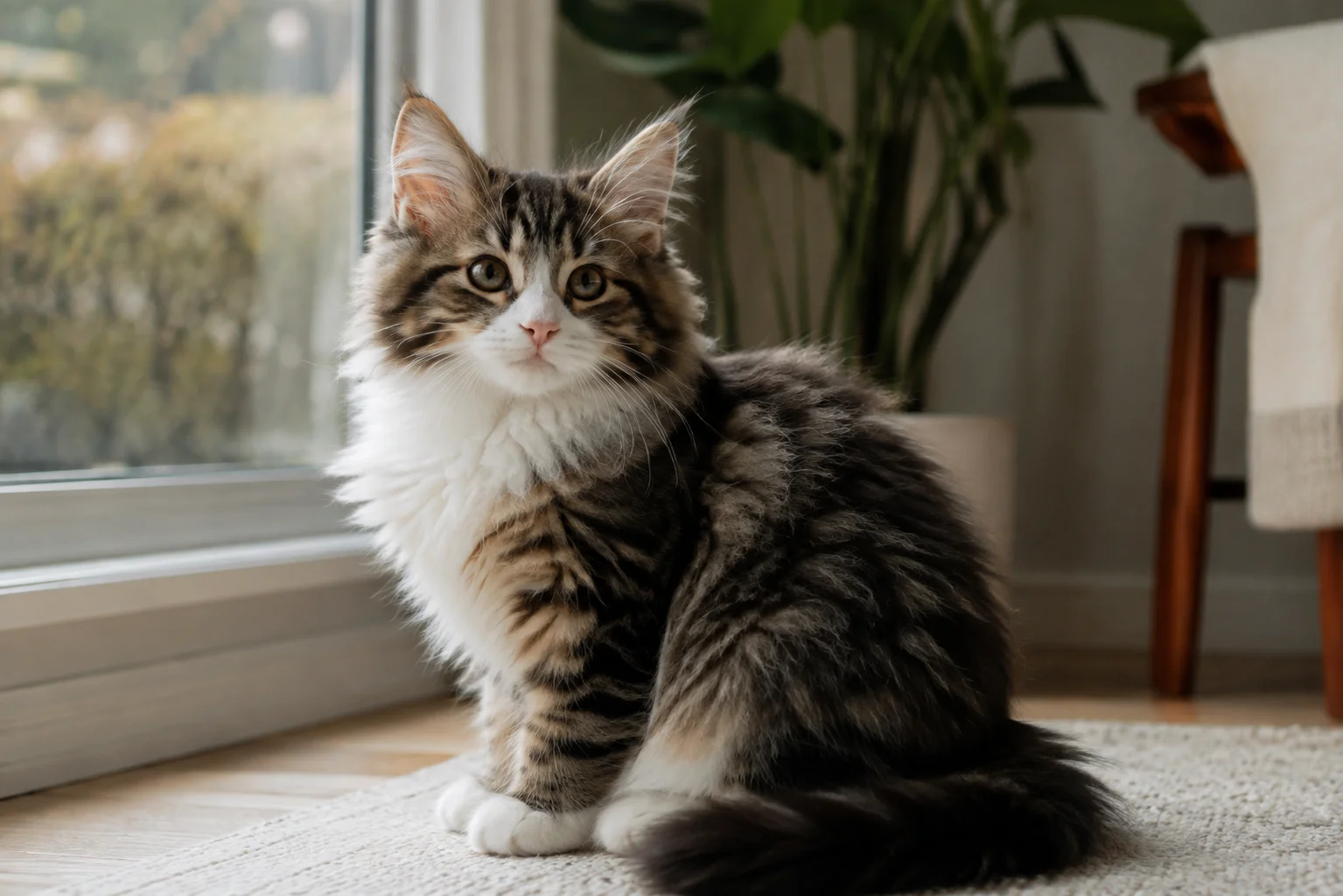
If you’re bringing home a Wegie kitten — or simply researching before you commit — this guide walks through everything from the first weeks of development to the products, routines, and training approaches that set a Norwegian Forest Cat kitten up for a healthy adulthood. It’s meant to work alongside your veterinarian’s guidance, not replace it.
Quick Facts
| Feature | Information |
|---|---|
| Breed | Norwegian Forest Cat (Norsk Skogkatt) |
| Expected growth pattern | Slow maturing large breed; full size typically not reached until 3–5 years old |
| Coat type | Semi longhaired double coat: dense woolly undercoat with a longer, water resistant top coat |
| Activity level | Moderate to high; bursts of energy, strong climbing instinct, followed by long rest periods |
| Grooming needs | Weekly brushing typically; more frequent during seasonal coat blowouts |
| Social needs | Affectionate but independent; enjoys being near people on its own terms |
| Diet | High quality kitten-formulated food with animal-based protein, appropriate for a large-breed kitten’s extended growth period |
| Typical development period | Kittenhood through roughly 12 months for major growth, with continued filling out to age 4–5 |
| Training | Responds well to litter training, scratching-post training, and positive-reinforcement handling |
| Family suitability | Generally good with children and other pets when introduced gradually |
Weight and maturation figures above reflect ranges published by the Cat Fanciers’ Association (CFA) breed profile; individual kittens vary.
Table of Contents
- What Are Norwegian Forest Cat Kittens Like?
- Norwegian Forest Cat Kitten Growth
- Norwegian Forest Cat Kitten Size and Weight
- Norwegian Forest Cat Kitten Growth Chart
- How to Feed a Norwegian Forest Cat Kitten
- Norwegian Forest Cat Kitten Feeding Schedule
- What Food Is Best for a Norwegian Forest Cat Kitten?
- Essential Products for a Norwegian Forest Cat Kitten
- Norwegian Forest Cat Kitten Care
- How to Groom a Norwegian Forest Cat Kitten
- Norwegian Forest Cat Kitten Training
- Norwegian Forest Cat Kitten Socialization
- Norwegian Forest Cat Kitten Exercise and Play
- How Much Sleep Does a Norwegian Forest Cat Kitten Need?
- Norwegian Forest Cat Kitten Health and Veterinary Care
- When Can a Norwegian Forest Cat Kitten Leave Its Mother?
- How Much Does a Norwegian Forest Cat Kitten Cost?
- Common Norwegian Forest Cat Kitten Mistakes
- How to Prepare Your Home for a Norwegian Forest Cat Kitten
- FAQ
What Are Norwegian Forest Cat Kittens Like?
Norwegian Forest Cat kittens are curious, athletic, and unusually confident for such young animals. Bred to survive Scandinavian winters as working farm and ship cats, the breed carries a strong climbing instinct into kittenhood — expect a Wegie kitten to scale curtains, bookshelves, and cat trees well before it’s fully coordinated. This is normal Norwegian Forest Cat kitten behavior, not a sign of a “hyper” cat.
Personality-wise, kittens of this breed tend to be:
- Playful in bursts. Short, intense play sessions followed by long naps are typical.
- Socially engaged but not clingy. Norwegian Forest Cat kittens like to be near their people — on a nearby chair or perch — rather than constantly in a lap.
- Independent problem-solvers. They investigate new objects and spaces methodically, which is part of good Norwegian Forest Cat kitten care: give them safe things to explore.
- Quiet. The breed is generally not vocal, communicating more through body language than meowing.
One important distinction for new owners: a Norwegian Forest Cat kitten looks and often acts more physically mature than it actually is. Because this is a slow-maturing breed, a six-month-old kitten can already be sizable while still behaving — and needing to be fed and handled — like the kitten it is. Adult Norwegian Forest Cats settle into a calmer, more predictable temperament, but that transition happens gradually over the first few years, not the first few months.
READ ARTICLE ON : Norwegian Forest Cat Diet
Norwegian Forest Cat Kitten Growth
Kitten development follows the same broad biological stages in every breed — neonatal, transitional, socialization, and juvenile — but Norwegian Forest Cats extend the process well past the point where most domestic cats have finished growing.

Early development (birth to about 8 weeks): Kittens are born with closed eyes and limited mobility, gain sight and hearing within the first couple of weeks, and become increasingly mobile and playful through weaning. This stage is largely managed by the breeder or foster, but it shapes the confidence and sociability the kitten arrives with.
Juvenile development (roughly 2–6 months): This is when most of the personality and coordination you’ll recognize as “kitten energy” appears — running, pouncing, climbing, and testing boundaries. Baby teeth are replaced by adult teeth during this window, which can affect chewing behavior and appetite.
Physical growth: Norwegian Forest Cat kittens build frame (bone and height) earlier and fill out muscle and body mass later, which is typical of large slow-maturing breeds. A kitten can look tall and long before it looks broad or heavy — that’s the frame-first growth pattern, not a health concern by itself.
Coat development: The signature double coat is not fully in at kitten age. Young Wegies often have a softer, less differentiated coat that gradually develops the coarser, water-resistant guard hairs and the fuller ruff, britches, and tail plume as they mature — a process that continues for a few years, alongside body growth.
Muscle and bone development: Because the skeleton and joints are still developing, high-impact jumping from excessive heights or overly vigorous handling should be limited in the first year. This matters more for a large breed than a small one, simply because there’s more mass moving through developing joints.
Transition toward adulthood: Most Norwegian Forest Cats reach a large share of their adult height and length within the first year but continue adding weight, muscle, and coat density for several more years — commonly cited as up to five years by breed authorities such as the CFA.
| Life Stage | Approximate Age | What’s Happening |
|---|---|---|
| Neonatal | Birth–2 weeks | Eyes and ears closed at birth, opening within the first couple of weeks; fully dependent on mother |
| Transitional | 2–4 weeks | Mobility, vision, and hearing develop rapidly; weaning begins |
| Socialization | 4–8 weeks | Play behavior emerges; critical window for positive human and environmental exposure |
| Juvenile | 2–6 months | Rapid frame growth, teething, high energy, coordination improving |
| Adolescent | 6–12 months | Continued growth in height/length; muscle and coat still filling in; sexual maturity possible if not yet spayed/neutered |
| Young adult | 1–3 years | Reaches much of adult height; body mass, muscling, and coat continue developing |
| Full maturity | Up to ~5 years | Full adult weight, muscle tone, and coat density typically reached, per CFA breed guidance |
Norwegian Forest Cat Kitten Size and Weight
Because Norwegian Forest Cats are a slow-maturing breed, kitten weight is a poor predictor of adult size on its own — two kittens from the same litter can grow at noticeably different rates and still end up healthy, appropriately sized adults.
According to the CFA breed standard, adult male Norwegian Forest Cats typically weigh in the range of 12 to 16 pounds, and adult females in the range of 9 to 12 pounds, with full growth sometimes taking up to five years. Other veterinary and breed sources cite a somewhat wider range — commonly citing adult males up to roughly 18–20+ pounds and females up to roughly 16–18 pounds — reflecting natural variation between individual cats and bloodlines. Treat any single number as a rough guide rather than a target.
Why individual kittens vary:
- Genetics and bloodline. Parents’ size is a stronger predictor than breed averages alone.
- Sex. Males are consistently larger than females in this breed, a pattern confirmed across CFA and other breed-standard sources.
- Nutrition and body condition. A kitten fed appropriately for its life stage grows at a steadier, healthier rate than one that’s over- or underfed.
- Neuter/spay status and timing, which can subtly influence growth patterns.
Rather than fixating on a scale number, most veterinarians recommend tracking body condition — whether ribs are easily felt but not visible, whether there’s a visible waist from above, and whether growth is steady over time. Your veterinarian can assess body condition score at each wellness visit and flag if a kitten is growing unusually fast, slow, or unevenly.
READ ARTICLE ON : Norwegian Forest Cat Cost
Norwegian Forest Cat Kitten Growth Chart
This chart is intended as a general roadmap, not a guarantee of exact measurements — always verify concerns about your kitten’s individual growth with a veterinarian rather than comparing against a fixed number.
| Age | Development Stage | Typical Changes | Feeding Considerations | Care Priorities |
|---|---|---|---|---|
| 0–8 weeks | Neonatal/socialization | Rapid early growth, weaning, first vaccinations begin | Nursing, then gradual transition to kitten food (managed by breeder) | Gentle handling, exposure to household sounds and people |
| 2–4 months | Juvenile | Noticeable frame growth, high energy, teething | Frequent small meals of kitten-formulated food | Litter training, scratching-post introduction, socialization |
| 4–6 months | Juvenile/adolescent | Continued height and length growth; adult teeth in | Kitten food continues; monitor appetite changes from teething | Vet visits for vaccination boosters; spay/neuter discussion |
| 6–12 months | Adolescent | Frame largely established; body starts filling out; coat texture begins changing | Kitten or “large breed kitten” formula recommended by many vets through this period | Increase environmental enrichment; monitor weight trend, not just weight |
| 1–2 years | Young adult | Muscle mass and coat density increasing | Transition to adult food per veterinarian’s guidance | Maintain grooming routine as coat thickens |
| 2–5 years | Continued maturity | Gradual filling out of chest, coat, and overall bulk | Adult maintenance diet, portioned to activity level | Regular weight checks to prevent overfeeding as growth slows |
How to Feed a Norwegian Forest Cat Kitten
Kittens have fundamentally different nutritional needs from adult cats. They require more protein and calories per pound of body weight to fuel rapid growth, brain development, and a developing immune system — and because Norwegian Forest Cats grow for longer than most breeds, that elevated need extends further into their first year or two.

Key nutritional considerations:
- Protein. Kitten food should list a named animal protein (chicken, turkey, fish) as the first ingredient. Protein supports muscle, coat, and organ development.
- Calories. Kitten formulas are more calorie-dense than adult formulas because kittens burn through energy quickly and have smaller stomach capacity relative to their needs.
- Hydration. Kittens should always have access to fresh water. Wet food also contributes meaningfully to hydration, which matters more for a breed that can be prone to certain urinary and kidney concerns later in life.
- Wet food vs. dry food vs. combination feeding. All three approaches can support healthy growth if the food is a complete and balanced kitten formula. Wet food offers hydration and palatability; dry food offers convenience and can support dental chewing behavior; many owners combine both.
- Treats. Keep treats to a small proportion of daily calories — as a general rule of thumb used by many veterinary nutritionists, no more than about 10% of total daily intake — so they don’t crowd out balanced nutrition.
- Fresh water. Change water daily and keep bowls away from food and litter to encourage drinking.
Ask your veterinarian how to adjust feeding as your kitten grows, since a large-breed kitten’s caloric needs don’t taper off on the same timeline as a standard domestic shorthair’s.
Norwegian Forest Cat Kitten Feeding Schedule
| Age/Stage | Meal Frequency | Food Considerations | Water | Important Notes |
|---|---|---|---|---|
| 8–12 weeks | 4 meals/day (typical range) | Kitten-formulated wet or dry food, easy to chew | Fresh water available at all times | Follow breeder’s transition diet initially to avoid GI upset |
| 3–6 months | 3–4 meals/day | Continue kitten formula; portion per food label and vet guidance | Fresh water available at all times | Monitor for teething-related appetite dips |
| 6–12 months | 2–3 meals/day | Kitten or large-breed kitten formula through this period | Fresh water available at all times | Ask your vet when to plan the adult-food transition for this slower-maturing breed |
| 12+ months | 2 meals/day (general guideline) | Transition to adult food gradually, mixing old and new over 7–10 days | Fresh water available at all times | Because Wegies mature slowly, some vets recommend keeping a kitten or “growth” formula longer than for other breeds — confirm with your vet |
This is a general framework, not a prescription — always confirm portion sizes and timing with your veterinarian or the food manufacturer’s guidelines, since they account for your specific kitten’s weight, activity, and body condition.
What Food Is Best for a Norwegian Forest Cat Kitten?
There’s no single commercial brand that’s universally “best” for every Norwegian Forest Cat kitten — the right choice depends on your kitten’s individual response, your veterinarian’s recommendation, and your budget. That said, here’s what to evaluate when comparing options:
- Complete and balanced nutrition. Look for an AAFCO statement confirming the food is formulated for kitten growth (not just “all life stages” without growth-stage substantiation).
- Animal-source protein first. Named meat, poultry, or fish should lead the ingredient list.
- Appropriate calorie density. Growing, large-breed kittens generally need more calories per pound than adult cats — the label should reflect a growth formulation.
- Hydration support. Wet food or a mix of wet and dry can help support hydration, particularly relevant to long-term urinary health.
- Kitten-specific formulation. Kitten foods are balanced differently than adult maintenance foods — don’t substitute one for the other long-term.
- Ingredient quality and sourcing transparency. Reputable brands are generally transparent about sourcing and manufacturing, and often have veterinary nutritionists on staff.
- Life-stage suitability as the kitten grows. Because this breed matures slowly, revisit the food conversation with your vet around the one-year mark rather than assuming a fixed cutoff.
For a deeper breakdown of nutrition specifics, see our related guide, Norwegian Forest Cat Diet, Feeding Schedule & Nutrition Guide.
Essential Products for a Norwegian Forest Cat Kitten
1. Kitten food
Why: Fuels the extended growth period unique to this breed. Look for: AAFCO growth-stage formulation, named animal protein first. Common mistake: Switching to adult food too early because the kitten “looks” grown.
2. Food and water bowls
Why: Supports consistent eating and hydration habits. Look for: Wide, shallow bowls that don’t press on facial whiskers. Common mistake: Bowls too small or deep, discouraging drinking.
3. Water fountain
Why: Encourages hydration, which many cats find more appealing from moving water. Look for: Easy-to-clean design, quiet motor. Common mistake: Skipping regular cleaning, which can deter kittens from using it. (See our upcoming guide, Best Water Fountain for Norwegian Forest Cats.)
4. Kitten-safe carrier
Why: Needed for vet visits and safe transport from day one. Look for: Secure latches, ventilation, size that will still work as the kitten grows. Common mistake: Buying a carrier sized only for kitten dimensions, requiring an early upgrade. (See Best Cat Carrier for Norwegian Forest Cats.)
5. Litter box
Why: Establishes reliable litter habits from the start. Look for: Low sides for kittens, larger size as the cat grows into a large breed. Common mistake: A box too small for an adult-sized Wegie later on. (See Best Litter Box for Norwegian Forest Cats.)
6. Kitten litter
Why: Supports safe, comfortable elimination habits. Look for: Unscented, low-dust options recommended for young kittens. Common mistake: Using clumping litter before it’s appropriate for very young kittens — check product guidance and ask your vet.
7. Scratching post
Why: Redirects natural scratching behavior away from furniture. Look for: Tall, sturdy posts that won’t tip under a large-breed cat’s weight. Common mistake: Choosing a post too short or unstable for an adult Wegie’s eventual size.
8. Cat tree
Why: Satisfies the breed’s strong climbing instinct. Look for: Wide base, sturdy platforms rated for a large adult cat. Common mistake: Undersized trees that can’t support the cat once grown.
9. Interactive toys
Why: Supports mental stimulation and hunting-style play. Look for: Wand toys, puzzle feeders, and rotating toy variety. Common mistake: Leaving string or ribbon-style toys unsupervised, which is a safety risk.
10. Grooming brush
Why: Maintains the developing double coat and reduces matting. Look for: A comb or slicker brush suited to semi-longhair coats. Common mistake: Starting grooming too roughly or too late, making the kitten resistant. (See Best Brush for Norwegian Forest Cats.)
11. Nail clippers
Why: Regular trims protect furniture and people. Look for: Cat-specific clippers with a safety guard. Common mistake: Cutting into the quick — go slowly and reward calm behavior.
12. Comfortable kitten bed
Why: Supports the long rest periods kittens need between play bursts. Look for: Washable, appropriately sized, placed in a quiet area. Common mistake: Expecting the kitten to only use the bed you bought — many kittens prefer a sunny windowsill or a shared spot with you.
For food specifics, see Best Kitten Food for Norwegian Forest Cats; for coat care essentials, see Norwegian Forest Cat Grooming, Shedding & Coat Care.
Norwegian Forest Cat Kitten Care
Good Norwegian Forest Cat kitten care is really a set of daily habits rather than a single checklist item:
- Feeding. Consistent mealtimes on an age-appropriate schedule (see feeding table above).
- Water. Fresh water always available, refreshed daily.
- Sleep. Kittens need substantial rest between activity bursts — don’t interrupt naps unnecessarily.
- Play. Multiple short interactive sessions daily, matched to the kitten’s energy bursts.
- Grooming. Regular brushing sessions, introduced gently and early.
- Litter box. Kept clean, scooped daily, sized appropriately as the kitten grows.
- Safety. Kitten-proofing the home (see checklist below) to prevent falls, toxic exposure, or entrapment.
- Socialization. Ongoing gentle exposure to people, sounds, and (eventually) other pets.
- Mental stimulation. Puzzle feeders, climbing opportunities, and rotating toys to prevent boredom.
READ ARTICLE ON : Norwegian Forest Cat Lifespan
How to Groom a Norwegian Forest Cat Kitten
Even though the adult double coat isn’t fully developed yet, starting a grooming routine early makes lifelong coat care far easier.

- Brushing. A few short sessions per week with a wide-toothed comb or slicker brush, gradually increasing as the coat thickens with age.
- Coat maintenance. Focus on areas prone to matting as the adult coat comes in — behind the ears, under the arms, and around the britches and ruff.
- Getting kittens comfortable with grooming. Keep early sessions short and positive, pairing brushing with treats or praise so it becomes a pleasant routine rather than a wrestling match.
- Nail care. Trim regularly, starting young so the kitten becomes accustomed to paw handling.
- Ear checks. Look for redness, odor, or excess debris during regular handling, and ask your vet about safe cleaning practices if needed.
- Dental care. Introduce tooth brushing or dental-support routines early — ask your veterinarian for a kitten-appropriate dental care plan.
Grooming needs will increase as the coat matures over the following years, particularly during seasonal coat blowouts, so think of kitten grooming as training for a routine you’ll maintain long-term.
Norwegian Forest Cat Kitten Training
Norwegian Forest Cat kittens generally respond well to patient, consistent, positive-reinforcement training.
- Litter training. Most kittens pick this up quickly with a clean, appropriately sized, easily accessible box; reward calm use rather than punishing accidents.
- Scratching-post training. Place posts near favored scratching spots and reward use with treats or praise; a sturdy, tall post matters for a large-breed cat.
- Handling. Regular, gentle handling of paws, ears, and mouth builds tolerance for future grooming and vet exams.
- Carrier training. Leave the carrier out as a normal part of the environment, with treats or bedding inside, so it’s not only associated with vet visits.
- Basic boundaries. Redirect unwanted behavior (like counter-jumping) toward an acceptable alternative rather than scolding after the fact.
- Positive reinforcement. Reward-based training — treats, praise, or play — is consistently the most effective and welfare-friendly approach for kittens. Punishment-based methods are not recommended, as they can damage trust and increase anxiety or unwanted behaviors rather than resolve them.
Norwegian Forest Cat Kitten Socialization
Early, gradual, positive exposure shapes a confident adult cat. Key socialization areas include:

- Humans. Regular, gentle handling from multiple people, including visitors, when appropriate.
- Children. Supervised interactions teaching gentle handling on both sides.
- Other cats. Slow, controlled introductions using scent swapping and gradual visual contact before direct interaction.
- Dogs. Introduced carefully and only once both animals are calm; never force proximity.
- New environments. Gradual exposure to different rooms, surfaces, and sounds within the home.
- Handling. Ongoing paw, ear, and mouth handling to build comfort with future grooming and vet visits.
- Sounds. Gentle exposure to household noises (vacuum, doorbell) at manageable volume.
- Grooming. Treated as a socialization opportunity, not just a maintenance task.
- Vet visits. Positive carrier association and calm handling reduce stress at appointments over time.
Because responsible breeders keep kittens with their mother and littermates through much of this critical window, a well-socialized kitten often arrives home already comfortable with many of these experiences — but the process continues in your household for months afterward.
Norwegian Forest Cat Kitten Exercise and Play
This breed’s working-cat ancestry shows up clearly in kitten play style:

- Interactive play. Wand toys that mimic prey movement tap into natural hunting instincts.
- Climbing. A strong drive to climb means vertical space (cat trees, shelving) is as important as floor space.
- Cat trees. Provide safe, sturdy structures scaled for a growing large-breed cat.
- Puzzle toys. Support mental stimulation alongside physical activity.
- Hunting-style games. Short bursts of chase-and-pounce play mirror natural behavior and burn energy effectively.
- Safe exercise. Because joints are still developing, avoid encouraging jumps from excessive heights in the first year.
How Much Sleep Does a Norwegian Forest Cat Kitten Need?
Like most kittens, Norwegian Forest Cat kittens sleep a large portion of the day — commonly cited by veterinary sources as somewhere in the range of many hours daily, tapering somewhat as they mature into adulthood. Exact totals vary by individual kitten, age, and activity level, so rather than tracking a specific number, watch for a healthy pattern: active, engaged play periods followed by deep, restful sleep, with a normal appetite and alertness when awake. A kitten that seems unusually lethargic, or conversely can’t settle at all, is worth mentioning to your veterinarian.
Norwegian Forest Cat Kitten Health and Veterinary Care
Preventive veterinary care is central to raising a healthy kitten, and it’s an area where general guidance should always defer to your own veterinarian’s specific recommendations for your kitten.
- Veterinary examinations. Kittens typically need a series of early wellness visits in their first few months, with your vet setting the specific schedule based on age, health status, and local disease risk.
- Vaccinations. Core kitten vaccines are generally administered in a series of visits during the first several months, followed by boosters — your veterinarian will confirm exact timing and which vaccines are appropriate for your kitten’s lifestyle and region.
- Parasite prevention. Deworming and flea/parasite prevention protocols are typically started early and adjusted as your vet recommends.
- Dental health. Early dental checks and at-home care habits help support long-term oral health.
- Weight monitoring. Because this breed grows over an extended period, regular weight and body-condition checks help your vet confirm growth is on track.
- Spaying/neutering discussion. Timing is an individual medical decision best made with your veterinarian, who will weigh breed size, growth rate, and your kitten’s specific health.
- Microchipping. A permanent identification option many vets recommend discussing at an early wellness visit.
The Norwegian Forest Cat breed has also been associated with certain hereditary conditions — including hypertrophic cardiomyopathy and glycogen storage disease — that responsible breeders test for. If you’re purchasing from a breeder, ask about health testing for the parents, and discuss any breed-specific screening recommendations with your veterinarian.
This section is general information, not personalized medical advice. Always consult your veterinarian for guidance specific to your kitten.
For a broader look at health considerations across the cat’s lifespan, see Norwegian Forest Cat Lifespan, Health Problems & Care Guide.
When Can a Norwegian Forest Cat Kitten Leave Its Mother?
Responsible Norwegian Forest Cat breeders typically keep kittens with their mother and littermates well beyond the minimum age common in many breeds — often to around 12 weeks of age, with many breeders and breed sources recommending 14 to 16 weeks. This extended timeline supports several things at once:
- Socialization. Extra time with littermates and the mother cat helps kittens learn bite inhibition, play boundaries, and general feline social skills.
- Weaning. A gradual, complete weaning process supports digestive health during the transition to solid food.
- Vaccination timing. Staying longer with the breeder often means kittens go home after completing more of their initial vaccination series.
- Responsible breeder practices. Major registries and breed clubs generally encourage this longer placement age for large, slow-maturing breeds specifically because of their extended developmental timeline.
If a breeder offers to release a Norwegian Forest Cat kitten significantly earlier than 12 weeks, it’s worth asking direct questions about their reasoning and health/vaccination protocols.
How Much Does a Norwegian Forest Cat Kitten Cost?
Costs generally fall into a few categories:
- Purchase price. Norwegian Forest Cat kittens from reputable breeders commonly range from several hundred to well over a thousand dollars, with higher prices for show-quality lines, though exact pricing varies widely by breeder, region, and pedigree.
- Adoption. Rescue or breed-specific rescue adoption fees are typically lower than breeder prices and often include some initial veterinary care.
- Initial supplies. Budget for a carrier, litter box, food, bedding, scratching post, and toys before the kitten arrives.
- Veterinary expenses. Early wellness visits, vaccination series, and spay/neuter surgery represent a meaningful first-year cost beyond the purchase price.
For a full breakdown of upfront and ongoing costs, see Norwegian Forest Cat Cost, Price & Monthly Expenses.
Common Norwegian Forest Cat Kitten Mistakes
- Overfeeding, especially once the kitten starts looking “grown” well before it actually is.
- Poor nutrition, such as feeding adult food too early or relying heavily on treats.
- Lack of socialization, particularly skipping gradual exposure to handling, new people, or other animals.
- Insufficient play, which can contribute to boredom-driven behavior problems.
- Ignoring grooming, which allows mats to form as the adult coat comes in.
- Unsafe climbing areas, like unstable furniture or shelving that can’t support a growing, athletic cat.
- Poor litter-box setup, including too few boxes, boxes that are too small, or infrequent cleaning.
- Skipping veterinary care, including delaying vaccinations or ignoring subtle changes in behavior or appetite.
- Using punishment for unwanted behavior instead of redirection and positive reinforcement, which tends to erode trust rather than resolve the underlying issue.
How to Prepare Your Home for a Norwegian Forest Cat Kitten
Before arrival
- Kitten-proof: secure loose cords, small objects, and toxic plants.
- Set up a quiet “home base” room with food, water, litter box, and bedding.
- Choose a veterinarian and schedule an initial wellness visit.
First day
- Keep the environment calm and let the kitten explore at its own pace.
- Introduce the litter box, food, and water locations immediately.
- Limit initial access to one or two rooms before expanding to the full home.
First week
- Begin gentle handling and grooming introductions.
- Start establishing consistent feeding and play routines.
- Watch appetite, litter habits, and energy level for anything unusual.
Long-term setup
- Add vertical space (cat trees, shelving) as the kitten’s climbing confidence grows.
- Scale up litter boxes, beds, and scratching posts as the kitten grows into a large adult.
- Maintain a consistent grooming and veterinary care schedule as the coat and body mature.
READ ARTICLE ON : Norwegian Forest Cat Personality
FAQ
How big do Norwegian Forest Cat kittens get?
Adult size varies by individual and sex. According to the CFA breed standard, adult males typically weigh 12–16 pounds and adult females 9–12 pounds, though other breed sources cite somewhat wider ranges. Full growth can take up to five years.
How fast do Norwegian Forest Cat kittens grow?
They grow steadily through the first year, reaching much of their height and length, but continue filling out in muscle, weight, and coat for several more years, since this is a recognized slow-maturing breed.
What should I feed a Norwegian Forest Cat kitten?
A complete and balanced kitten-formulated food with animal protein as the first ingredient, chosen in consultation with your veterinarian based on your kitten’s growth and health needs.
How often should a Norwegian Forest Cat kitten eat?
Younger kittens typically eat several small meals a day, gradually tapering toward fewer, larger meals as they approach adulthood your veterinarian can confirm the right schedule for your kitten’s age and weight.
Are Norwegian Forest Cat kittens easy to train?
Most respond well to positive-reinforcement training for litter use, scratching posts, and handling, particularly with early, consistent, reward-based routines.
Are Norwegian Forest Cat kittens good with children?
Generally yes, especially with supervised, gentle introductions on both sides, though individual temperament and socialization history matter.
Do Norwegian Forest Cat kittens need lots of grooming?
Grooming needs are moderate as kittens but increase as the adult double coat develops; weekly brushing is a reasonable baseline, more during seasonal shedding.
How much sleep does a Norwegian Forest Cat kitten need?
Kittens sleep a large portion of the day, similar to other breeds, tapering somewhat with age; watch for a healthy balance of active play and restful sleep rather than tracking an exact hour count.
When can a Norwegian Forest Cat kitten leave its mother?
Responsible breeders commonly wait until around 12 weeks, with many recommending 14–16 weeks, given the breed’s extended socialization and developmental needs.
Are Norwegian Forest Cat kittens good with other pets?
Generally adaptable with gradual, positive introductions to other cats and dogs, though every individual animal’s temperament plays a role.
Do Norwegian Forest Cat kittens shed a lot?
Shedding is generally moderate day-to-day but increases noticeably during seasonal coat changes as the adult coat matures.
Is a Norwegian Forest Cat kitten a good choice for a first-time owner?
Many first-time owners do well with this breed thanks to its adaptable, low-maintenance-coat-for-its-length temperament, though the extended growth period and grooming commitment are worth planning for in advance.
When should a Norwegian Forest Cat kitten be spayed or neutered?
Timing is an individual medical decision best made with your veterinarian, who will factor in the breed’s size and growth rate.
Do Norwegian Forest Cat kittens need a special large-breed diet?
Some veterinarians recommend a large-breed or extended-growth kitten formula given how long this breed takes to mature; ask your vet what’s appropriate for your kitten specifically.
How much does a Norwegian Forest Cat kitten cost overall in the first year?
Total first-year cost includes the purchase or adoption fee, initial supplies, and veterinary care such as vaccinations and spay/neuter surgery — see our dedicated cost guide for a fuller breakdown.
Conclusion
Raising a Norwegian Forest Cat kitten is a longer commitment than raising most domestic kittens — not because the early months look dramatically different, but because the growth, coat development, and behavioral maturation stretch out over several years instead of one. Getting the fundamentals right early — age-appropriate kitten nutrition, gentle and consistent grooming habits, positive-reinforcement training, and regular veterinary care — sets up a Norwegian Forest Cat kitten to grow into the calm, confident, gentle-giant adult the breed is known for. When in doubt on any growth, feeding, or health question specific to your kitten, your veterinarian remains the best source of individualized guidance.
RESOURCES FOR DATA
- CFA Norwegian Forest Cat breed profile
- PetMD Norwegian Forest Cat breed guide
- CatLink — How Big Are Norwegian Forest Cats at a Year Old
- PetPlace Norwegian Forest Cat breed guide
- CFA cattery info — norwegian-cat.com
- Catster — Norwegian Forest Cat Size Compared
- Basepaws Norwegian Forest Cat breed info