Norwegian Forest Cat Cost, Price, Adoption & Monthly Expenses (2026 Guide)
Write by ALI HAMZA | Review by MUHAMMAD RAMZAN ( Cat product reviewer )
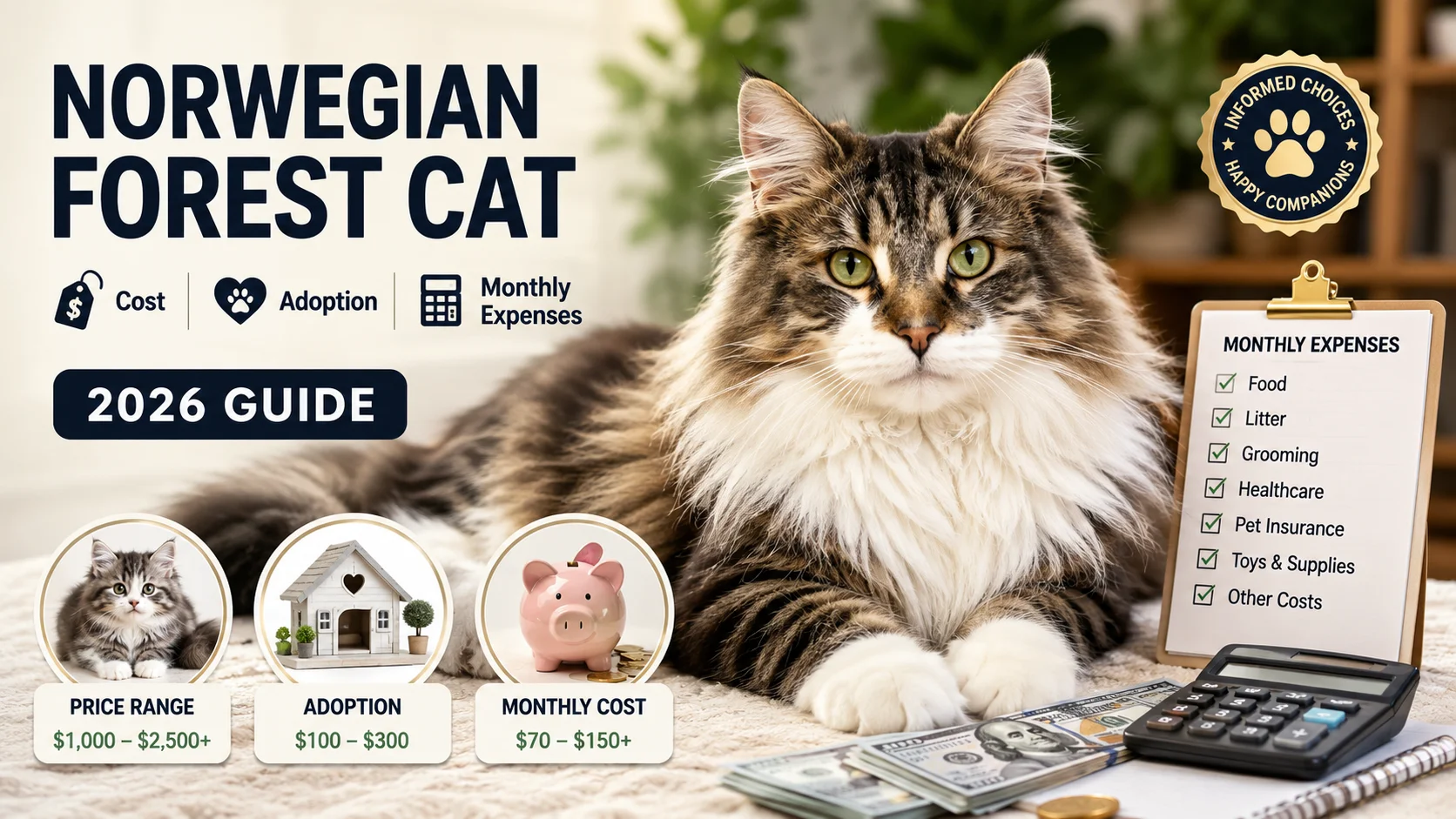
A Norwegian Forest Cat typically costs $800 to $1,800 for a pet-quality kitten from a reputable breeder, $1,800 to $4,000+ for a show-quality kitten from champion bloodlines, and $75 to $300 to adopt from a shelter or breed-specific rescue. Beyond the purchase price, first-year ownership (supplies, vaccinations, and initial vet care) typically adds $1,000 to $2,500, and ongoing monthly costs run $85 to $180, driven mostly by food, litter, grooming tools, and preventive veterinary care. Because this is a large, long-haired breed, expect food and grooming costs to sit at the higher end of typical cat-ownership budgets.
Quick Cost Summary
| Expense Category | Typical Cost |
|---|---|
| Pet-quality kitten (breeder) | $800 – $1,800 |
| Show/champion-line kitten (breeder) | $1,800 – $4,000+ |
| Adoption fee (shelter/rescue) | $75 – $300 |
| First-year total cost | $1,800 – $5,500 |
| Average monthly cost (after year one) | $85 – $180 |
| Average annual cost (after year one) | $1,000 – $2,100 |
| Estimated lifetime cost (14–16 year lifespan) | $15,000 – $30,000+ |
Figures are U.S. national averages and vary by region, breeder, and individual cat’s health needs. This guide will not present a single number as an exact price — instead, it explains the range and what drives it, so you can budget with confidence.
How Much Does a Norwegian Forest Cat Cost?
The average purchase price for a Norwegian Forest Cat (often nicknamed a “Wegie,” from the Norwegian Norsk skogkatt) is $800 to $1,800 for a healthy, pet-quality kitten from a breeder who health-tests their cats and is registered with an organization like The International Cat Association (TICA) or the Cat Fanciers’ Association (CFA). Show-quality kittens from proven champion bloodlines can run $1,800 to $4,000 or more.
Why prices vary so much
A few structural factors explain the wide range:
- Breed rarity in the U.S. Norwegian Forest Cats originated in Scandinavia and remain far less common in North America than popular breeds like Maine Coons or Ragdolls. Fewer than a few dozen TICA- or CFA-registered Wegie breeders operate in the entire United States, so limited supply keeps prices elevated.
- Health screening costs. Responsible breeders test breeding cats for genetic conditions common in the breed, including Glycogen Storage Disease IV (GSD IV) and hypertrophic cardiomyopathy (HCM). These tests, along with veterinary care for the breeding queens and litters, are built into the purchase price.
- Pedigree and show potential. Kittens from champion or grand-champion bloodlines, or those judged to have strong show-ring conformation, command a premium over pet-quality littermates.
- Coat color. Amber-eyed, silver, or striking color combinations sometimes carry a premium simply because of buyer demand — not because they indicate better health.
- Geographic location. Breeders in major metro areas or regions with few local catteries may charge more, partly to offset travel and import costs when foundation cats are sourced from Norway or established European lines.
Price range at a glance
| Kitten Tier | Typical Price | What You’re Paying For |
|---|---|---|
| Pet quality | $800 – $1,800 | Healthy, vet-checked, vaccinated, not intended for showing/breeding |
| Show quality | $1,800 – $2,500 | Strong conformation, may be shown but not necessarily bred |
| Champion/breeding lines | $2,500 – $4,000+ | Proven pedigree, breeding rights, top-tier health clearances |
| Adoption (rescue/shelter) | $75 – $300 | Often already spayed/neutered, vaccinated, and microchipped |

Norwegian Forest Cat Kitten Price
Not all Norwegian Forest Cat kittens are priced the same, even within a single litter. Breeders generally sort kittens into tiers based on quality and purpose.
Pet quality
Pet-quality kittens make up the majority of any litter and are sold without breeding rights, usually under a spay/neuter contract. They are just as healthy as their show-quality littermates — the classification reflects conformation to breed standard, not wellbeing. Expect to pay $800 to $1,800.
Show quality
Show-quality kittens more closely match the breed standard set by registries like CFA and TICA — features such as head shape, coat texture, ear tufts, and body proportions. These kittens are priced higher, typically $1,800 to $2,500, because breeders invest more in identifying and raising them to showcase the breed’s best traits.
Champion bloodlines
Kittens descended from champion or grand-champion titled cats, especially those sold with breeding rights, sit at the top of the market at $2,500 to $4,000+. Buyers here are usually other breeders or serious exhibitors, not first-time pet owners.
Breeder reputation
An established, registered breeder with a track record of health-tested litters, years of pedigree documentation, and positive buyer references will almost always charge more than an unregistered or hobbyist breeder — and that premium is generally worth paying. Cutting corners on breeder reputation is one of the most common ways buyers end up with unexpected veterinary bills later.
Health testing
Reputable breeders test breeding cats for GSD IV and HCM and provide documentation. Ask to see these results before paying a deposit. This testing is a legitimate cost driver and one of the clearest signals of a responsible breeding program.
Registration
Kittens sold with registration papers (TICA or CFA) cost more than unregistered kittens, since registration confirms pedigree and breed lineage. Registration itself is not a health guarantee, but it does support traceability back to health-tested parent cats.
Norwegian Forest Cat Adoption vs. Buying
Adoption is almost always the lower-cost path, but it isn’t right for everyone. Norwegian Forest Cats are uncommon in general shelters; most adoptable Wegies come through breed-specific rescues, purebred rescue networks, or owner surrenders.
| Factor | Adoption | Buying from a Breeder |
|---|---|---|
| Typical cost | $75 – $300 | $800 – $4,000+ |
| Spay/neuter included | Usually yes | Rarely (pet-quality contracts often require it separately) |
| Vaccinations included | Usually yes | Usually, for first-round kitten shots |
| Health history known | Sometimes limited | Documented through health testing |
| Kitten availability | Low — mostly adults | High — kittens are the norm |
| Wait time | Can be long due to rarity | Often several months on a waitlist |
| Pedigree documentation | Rare | Standard with registered breeders |
| Best suited for | Budget-conscious adopters open to an adult cat | Buyers wanting a kitten, pedigree, or show/breeding prospect |
Benefits of adoption
- Significantly lower upfront cost
- Often already spayed/neutered and vaccinated, offsetting part of the savings against first-year costs
- Gives an adult or senior purebred cat a home when rescues take in owner-surrendered Wegies
Potential drawbacks of adoption
- Limited availability — you may wait months for a Norwegian Forest Cat to appear in a rescue
- Health and genetic history may be incomplete
- Fewer kittens available; most rescues place adults
Benefits of buying from a breeder
- Kitten selection and ability to choose based on temperament and color
- Documented health testing and pedigree
- Breeder support and guidance, often including a health guarantee
Potential drawbacks of buying
- Substantially higher upfront cost
- Waitlists of several months to over a year for reputable breeders
- Risk of poor-quality breeding if you don’t vet the breeder carefully
READ ARTICLE ON : Norwegian Forest Cat Personality

Factors That Affect the Price
Several variables move the price of an individual Norwegian Forest Cat up or down within the ranges above:
- Location. Breeders in regions with few local catteries, or in high cost-of-living metro areas, often charge more. Import costs from Norwegian or European bloodlines can also raise regional prices.
- Age. Kittens are priced highest; retired breeding adults or older cats are usually cheaper, sometimes significantly so, when rehomed by a breeder or rescue.
- Gender. Some breeders price males and females slightly differently based on demand, though this varies by cattery and isn’t universal.
- Pedigree. More generations of documented, health-tested ancestry raise the price, particularly if champion titles appear in the lineage.
- Health screening. Kittens from parents tested for GSD IV and HCM cost more than those from untested lines — and this is a cost worth paying for, given the health stakes.
- Vaccinations. Kittens sold with a completed or partially completed vaccination series are typically priced to reflect that included veterinary care.
- Microchip. A pre-installed microchip, often bundled with the sale price, adds a modest but real cost that saves you a vet visit later.
- Breeder reputation. As noted above, an established, responsible breeder commands a premium over a casual or unregistered breeder — and that premium buys real risk reduction.
First-Year Cost Breakdown
The first year of Norwegian Forest Cat ownership costs meaningfully more than any later year because it includes the purchase or adoption fee plus one-time setup items. Because Wegies are a large breed with a dense, water-resistant double coat, some items — carriers, cat trees, and grooming tools — should be sized and rated for a bigger, heavier cat, which can push costs slightly above generic cat-ownership estimates.
| Item | Estimated Cost (Year One) |
|---|---|
| Purchase price (pet-quality kitten) or adoption fee | $800 – $1,800 (buy) / $75 – $300 (adopt) |
| Initial vet exam and follow-up visits | $150 – $300 |
| Vaccinations (if not already included) | $75 – $150 |
| Spay/neuter (if not already done) | $150 – $350 |
| Microchip (if not already included) | $25 – $60 |
| Carrier (large-breed sized) | $40 – $120 |
| Cat tree (sturdy, tall — sized for a large cat) | $80 – $300 |
| Litter box and starter litter | $30 – $100 |
| Grooming tools (brush, comb, deshedding tool) | $30 – $80 |
| Toys | $30 – $80 |
| Food and water bowls | $15 – $40 |
| First-year food | $250 – $500 |
| Pet insurance (optional, per year) | $150 – $500 |
| Emergency fund contribution (recommended) | $300 – $1,000 |
| Estimated first-year total (buying) | $1,975 – $5,380 |
| Estimated first-year total (adopting) | $1,175 – $3,410 |
Note: Ranges reflect real variation in food quality, insurance plan, and regional vet pricing. Treat the low end as a lean, budget-conscious setup and the high end as a fuller, premium setup — not as separate “correct” numbers.
Monthly Expenses of Norwegian Forest Cat
After the first year, costs settle into a more predictable monthly rhythm. Norwegian Forest Cats are large cats — often 12 to 20+ pounds for males — so food volume runs a bit higher than for an average-sized housecat.
| Expense | Estimated Monthly Cost |
|---|---|
| High-quality cat food | $30 – $65 |
| Litter | $15 – $35 |
| Treats | $5 – $20 |
| Pet insurance | $20 – $45 |
| Routine veterinary care (averaged) | $15 – $40 |
| Grooming supplies/services (averaged) | $5 – $20 |
| Replacement toys (averaged) | $5 – $15 |
| Estimated monthly total | $85 – $180 |
Annualized, that works out to roughly $1,000 to $2,100 per year in steady-state ownership costs, before accounting for any unexpected illness or injury.

Lifetime Cost of Owning a Norwegian Forest Cat
Norwegian Forest Cats are a relatively long-lived breed, with a typical lifespan of 14 to 16 years, and some living into their late teens with good care. Multiplying the steady-state annual cost ($1,000–$2,100) by an average lifespan, and adding the first-year setup and purchase price, puts total lifetime cost in the range of:
$15,000 to $30,000+
What pushes a cat toward the higher end of that range:
- Choosing premium or prescription food long-term
- Carrying comprehensive pet insurance versus self-insuring
- Living in a higher cost-of-living region with pricier veterinary care
- Managing a chronic health condition, which is more likely in the later years of life
- Higher grooming needs if the coat isn’t maintained consistently (matting can require professional de-matting or vet intervention)
What keeps a cat toward the lower end:
- Adopting rather than buying
- Consistent preventive care that catches problems early, when they’re cheaper to treat
- A stable, healthy weight maintained through appropriate portioning
- DIY grooming instead of professional grooming services
READ ARTICLE ON : Norwegian Forest Cat Lifespan
Essential Supplies Before Bringing One Home
Food and water bowls
Because Wegies are a large breed with prominent whiskers, wide, shallow bowls (ceramic or stainless steel) are generally more comfortable than deep, narrow bowls that cause whisker fatigue. Stainless steel and ceramic are also easier to sanitize than plastic, which can harbor bacteria and contribute to chin acne.
Cat tree
This is a genuinely large, athletic breed that climbs and needs vertical space. Look for a tall, heavy-based cat tree explicitly rated for large cats — an undersized or flimsy tree will tip or wear out quickly under a 15+ pound cat.
Scratching post
A tall, sturdy sisal-covered post (vertical) or a dense corrugated cardboard scratcher (horizontal) gives your cat an appropriate outlet and protects furniture. Norwegian Forest Cats’ size means posts should be tall enough for a full-body stretch.
Brush
A slicker brush or a wide-toothed brush designed for long, dense double coats helps manage the breed’s heavy seasonal shedding, especially during spring and fall coat blow.
Comb
A stainless steel comb with wide and narrow teeth is useful for working through the undercoat and catching early mats before they tighten against the skin.
Carrier
Choose a hard-sided or well-ventilated soft carrier rated for a large cat — many standard carriers marketed for “average” cats are too small for an adult Wegie to turn around comfortably.
Litter box
A large, high-sided litter box (or a large uncovered box, since some cats dislike enclosed boxes) accommodates this breed’s size better than a standard small box.
Bed
A wide, supportive bed — cave-style or a flat, plush option — gives a large-bodied cat room to stretch out fully.
Interactive toys
Wand toys, puzzle feeders, and rotating toy selections keep an intelligent, active breed mentally stimulated and help prevent boredom-related behavior issues.
Water fountain
Norwegian Forest Cats often show interest in moving water, and a fountain can encourage better hydration, which supports urinary tract health.

Recommended Product Categories (Large-Breed Sized)
Because a Norwegian Forest Cat can outgrow standard-sized cat gear, it’s worth shopping specifically within “large cat” or “large breed” product lines rather than generic ones. Rather than pointing to any single brand, the links below are independent buying guides that compare current, tested options in each category — use them to compare specs (weight capacity, interior dimensions, platform size) against your own cat’s size:
- Cat trees for large breeds — compare weight capacity and base stability: The 10 Best Cat Trees for Large Breeds (theconsumers.guide)
- Carriers for large cats — check interior length/height, not just weight rating: 10 Best Cat Carriers for Large Cats (Catster)
- Litter boxes for large cats — look for 24+ inch length and high sides: 10 Best Litter Boxes for Large Cats (Catster)
- Brushes and combs for long/double coats — slicker brushes, undercoat rakes, and wide-tooth combs: 10 Best Cat Brushes (NBC News Select)
- Cat water fountains — stainless steel or ceramic tend to resist bacteria better than plastic: 11 Best Cat Water Fountains (Catster)
Note: These are independent, third-party comparison guides, not manufacturer or affiliate placements from this article. Always check current interior dimensions and weight ratings against your own cat’s size before buying — some “large cat” branding doesn’t match an adult Wegie’s actual proportions.
How to Save Money Without Sacrificing Your Cat’s Health
- Enroll in pet insurance early, ideally while your kitten is young and before any pre-existing conditions appear — premiums are lower and coverage is broader for young, healthy cats.
- Prioritize preventive care. Annual (or biannual for seniors) wellness exams catch problems while they’re cheap to treat, rather than after they become emergencies.
- Buy litter and food in bulk from reputable retailers rather than in small quantities, which usually cost more per unit.
- Learn basic at-home grooming — brushing and nail trims you can do yourself reduce reliance on professional groomers.
- Compare veterinary pricing across a few local clinics for non-emergency procedures like spay/neuter or dental cleanings.
- Avoid impulse-buying supplies. A tall cat tree and a sturdy scratching post prevent furniture damage that costs far more to replace than the supplies themselves.
- Maintain a healthy weight. Obesity-related conditions (diabetes, joint strain) are among the most expensive chronic issues to manage long-term.
- Set aside a monthly emergency fund instead of paying nothing and risking a large, unplanned bill later.
Common Mistakes Buyers Make
- Choosing the cheapest available kitten without checking health testing or breeder reputation
- Skipping a written health guarantee or contract
- Underestimating grooming needs for the breed’s dense double coat
- Buying supplies sized for an average cat instead of a large breed
- Not budgeting for the first-year setup costs on top of the purchase price
- Delaying pet insurance until after a health issue appears (which can trigger pre-existing condition exclusions)
- Assuming adoption will always be faster than buying — breed-specific rescues can have long waitlists too, given how
uncommon the breed is - Not asking to see both parent cats or health clearance documentation before paying a deposit
How to Choose a Responsible Breeder or Adoption Center
Health testing
Ask specifically whether both parent cats have been screened for GSD IV and HCM, and request to see documentation rather than taking a verbal assurance at face value.
Questions to ask a breeder
- Can I see health clearance documents for both parents?
- Is the breeder registered with TICA, CFA, or another recognized registry?
- Can I visit the cattery or see the kitten with its mother in person or via video call?
- What is included in the price (vaccinations, microchip, registration papers, health guarantee)?
- What is the spay/neuter policy for pet-quality kittens?
- What ongoing support does the breeder offer after purchase?
Warning signs
- Reluctance to share health testing documentation
- Kittens available younger than 12 weeks old
- No willingness to let you see the kitten in person or via live video
- Multiple breeds or litters constantly available, suggesting high-volume breeding
- Prices significantly below market range with no clear explanation
Ethical considerations
Responsible breeding prioritizes the health of the breed over volume or profit. A slightly higher price from a health-testing, registered breeder generally reflects real costs — genetic screening, veterinary care, and proper socialization — rather than simple markup. If adopting, look for breed-specific rescues that disclose what health and behavioral history they do and don’t have on the cat.
READ ARTICLE ON : Norwegian Forest Cat Size
Frequently Asked Questions
How much does a Norwegian Forest Cat cost on average?
Most pet-quality kittens from a reputable breeder cost between $800 and $1,800. Show or champion-line kittens can cost $1,800 to $4,000 or more, while adoption typically runs $75 to $300.
Why are Norwegian Forest Cats so expensive compared to other breeds?
Their relative rarity in the U.S., the cost of genetic health screening for conditions like GSD IV and HCM, and the limited number of registered breeders all contribute to higher prices than more common breeds.
Is it cheaper to adopt a Norwegian Forest Cat than to buy one?
Yes. Adoption fees ($75–$300) are almost always lower than breeder prices, though adoptable Norwegian Forest Cats are less common and you may wait longer to find one, and are more likely to be an adult than a kitten.
How much does it cost to own a Norwegian Forest Cat per month?
Ongoing monthly costs typically range from $85 to $180, covering food, litter, treats, insurance, routine veterinary care, and grooming supplies.
Do Norwegian Forest Cats need pet insurance?
It isn’t required, but it’s worth strongly considering. Insurance premiums average $20 to $45 per month and can significantly offset the cost of an unexpected illness or injury, especially given this breed’s known predisposition to HCM.
What is the first-year cost of owning a Norwegian Forest Cat?
Including purchase or adoption fees plus one-time setup costs (supplies, vaccinations, initial vet visits), the first year typically totals $1,800 to $5,500, depending on whether you buy or adopt and how much you spend on supplies.
How much does a Norwegian Forest Cat kitten cost from a breeder?
Pet-quality kittens run $800 to $1,800. Show-quality kittens are typically $1,800 to $2,500, and kittens from champion breeding lines can reach $2,500 to $4,000 or more.
Are Norwegian Forest Cats more expensive to feed than average cats?
Somewhat. Their large size means they generally eat more than an average housecat, so food costs tend to sit at the higher end of typical cat-food budgets.
What health tests should Norwegian Forest Cat parents have before I buy a kitten?
Ask for documented screening for Glycogen Storage Disease IV (GSD IV) and hypertrophic cardiomyopathy (HCM), the two genetic conditions most closely associated with the breed.
How long do Norwegian Forest Cats live, and how does that affect lifetime cost?
They typically live 14 to 16 years. A longer lifespan means more total years of food, litter, and veterinary care, which puts estimated lifetime ownership cost in the range of $15,000 to $30,000 or more.
Do I need special supplies because Norwegian Forest Cats are a large breed?
Yes — a large-breed-rated carrier, a tall and sturdy cat tree, and a bigger litter box are all worth the modest extra cost compared to standard-sized versions, which this breed can outgrow or overwhelm.
Is a Norwegian Forest Cat a good choice for a first-time cat owner on a budget?
It can be, especially through adoption, but buyers should budget realistically for the breed’s higher purchase price, larger supply needs, and grooming requirements rather than assuming it will cost the same as an average shorthair cat.
Sources & References
Cost figures in this guide reflect a synthesis of ranges reported across multiple independent 2026 pricing and pet-cost sources, cross-checked against one another rather than taken from a single site:
- Norwegian Forest Cat Price: 2026 Cost Guide — Petful
- Norwegian Forest Cat Cost — BubblyPet
- How Much Does A Norwegian Forest Cat Cost? — Hepper
- Norwegian Forest Cat Adoption — Adopt a Pet
- How Much Does a Norwegian Forest Cat Cost? — Spot Pet Insurance
- How Much Does It Cost to Own a Cat? — PocketGuard
- The Cost of Cat Parenthood in 2026 — Rover
- How Much It Costs to Own a Cat / How Much Do Cats Cost — Insurify and Insurify (breed cost breakdown)
- How Much Does a Cat Cost? 2026 Price Guide — Catster
This article does not cite any single source as the definitive price; where sources disagreed, the overlapping middle of their ranges was used rather than the highest or lowest figure reported. Always confirm current pricing directly with breeders, shelters, and veterinary clinics in your area, since costs vary by region and change over time.
Conclusion
A Norwegian Forest Cat is a meaningful financial commitment before you even factor in day-to-day care: expect $800–$1,800 for a pet-quality kitten (more for show or champion lines), or $75–$300 through adoption, plus $1,000–$2,500 in first-year setup costs and roughly $85–$180 per month afterward. Over a typical 14- to 16-year lifespan, total ownership cost lands somewhere between $15,000 and $30,000 or more, depending on your choices around insurance, food quality, and veterinary care.
The right decision comes down to your budget, your timeline, and whether you value the predictability of a health-tested kitten from a reputable breeder or the lower upfront cost of adoption. Either path can work well — what matters most is going in with a realistic budget and a plan for both routine and unexpected expenses.
To go deeper on specific parts of Wegie ownership, see our related guides on Norwegian Forest Cat Personality, Norwegian Forest Cat Size and Norwegian Forest Cat Lifespan