Norwegian Forest Cat Size: Weight, Growth & Appearance Guide (2026)
Write by ALI HAMZA
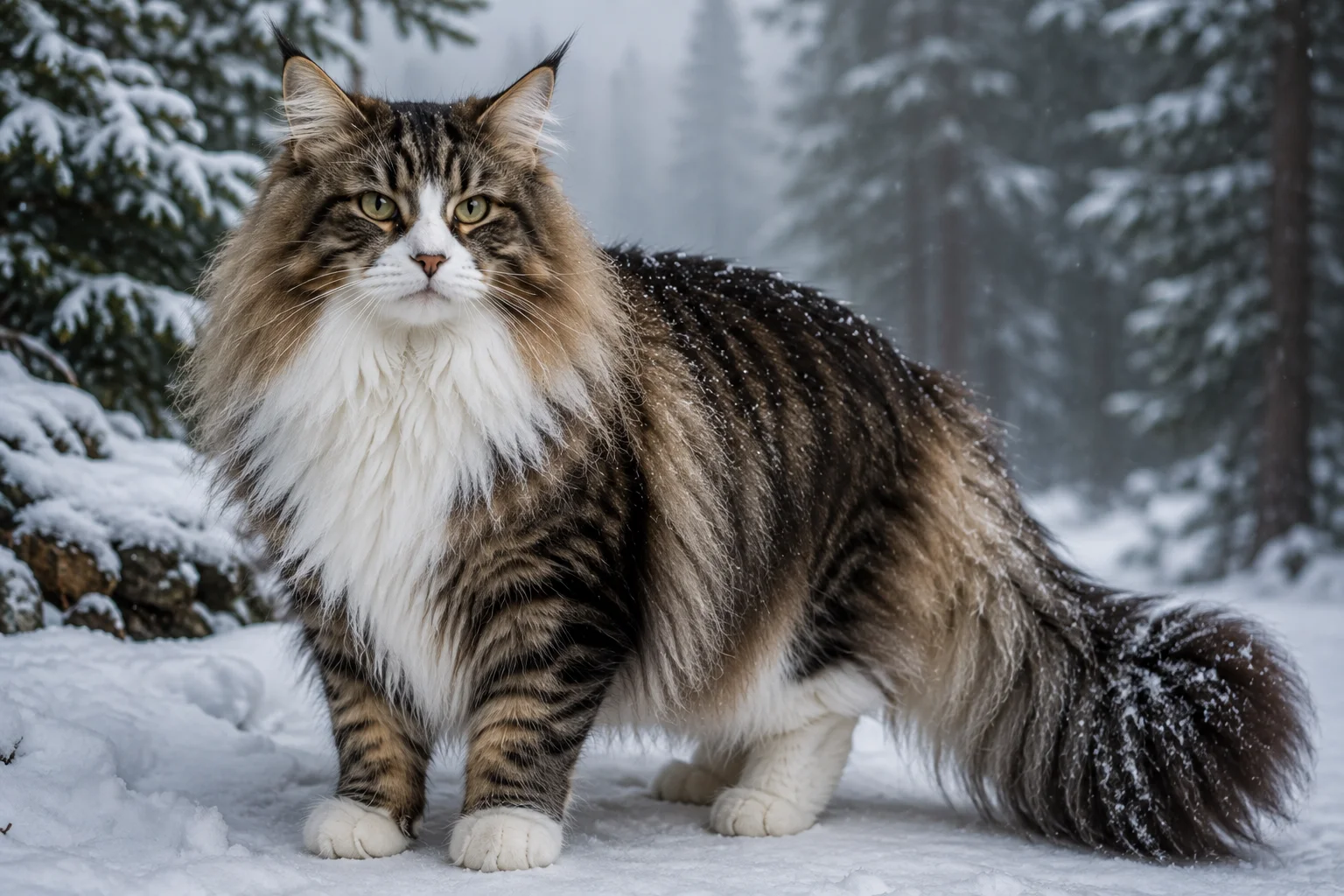
Quick answer: Norwegian Forest Cats are among the largest domestic cat breeds. Males typically weigh 12–16 lbs (5.4–7.3 kg) and females 9–12 lbs (4–5.5 kg), standing 9–12 inches tall at the shoulder and reaching 24–38 inches nose-to-tail. Their large frame, thick double coat, and bushy tail create a bigger visual impression than their actual bone structure — and they don’t reach full size until 4–5 years old.
Quick Facts

| Trait | Typical Range |
|---|---|
| Average Weight | Males: 12–16 lbs (5.4–7.3 kg) · Females: 9–12 lbs (4–5.5 kg) |
| Average Height | 9–12 inches (23–30 cm) at the shoulder |
| Average Length | 24–38 inches (61–96 cm), nose to tail tip |
| Growth Period | Full maturity at 4–5 years old |
| Coat Type | Long, water-resistant double coat |
| Body Type | Semi-cobby to rectangular, muscular, sturdy boning |
| Tail | Long, thick, and heavily plumed |
| Life Stage Terms | Kitten (0–6 mo) → Junior (6–12 mo) → Young Adult (1–2 yr) → Adult (2–4 yr) → Mature Adult (4 yr+) |
Note: These figures reflect general ranges reported by breed clubs and veterinary sources, not strict enforced standards. Individual cats vary based on genetics, sex, neuter status, and diet.
How Big Is a Norwegian Forest Cat?
The Norwegian Forest Cat (“Wegie” to fans of the breed) is a large, sturdily built cat native to Norway, where it developed a substantial frame and dense coat to survive cold Scandinavian winters. On average, a full-grown Norwegian Forest Cat weighs somewhere between 9 and 16 pounds, though well-built males can exceed that range. What sets the breed apart isn’t just raw weight — it’s the combination of a long, muscular body, large bone structure, and a coat so dense it can make a cat look considerably bigger than it actually is under all that fur.
Among recognized domestic breeds, the Norwegian Forest Cat is regularly listed alongside the Maine Coon and the Siberian as one of the largest. Cat fancier organizations like The International Cat Association (TICA) and the Cat Fanciers’ Association (CFA) describe the breed standard in terms of overall proportion and structure rather than exact weight, but both emphasize a strong, well-muscled body with substantial bone — language that reflects a breed built for size and endurance, not delicacy.
Three factors drive that “large domestic cat” impression:
- Frame: Long body, deep chest, and heavy boning compared to average shorthair breeds.
- Coat: A thick double coat with a wooly undercoat adds visual bulk, especially around the neck (the “ruff”), britches, and tail.
- Slow maturation: Unlike most cats, which reach adult size by 12–18 months, Norwegian Forest Cats keep filling out for several more years, so their “final” size surprises a lot of owners.
Norwegian Forest Cat Size
Average Height
Norwegian Forest Cats stand roughly 9 to 12 inches (23–30 cm) at the shoulder. This is only modestly taller than an average domestic cat — the breed’s size comes more from length and mass than from height.

Average Length
Measured from nose to the tip of the tail, adults typically run 24 to 38 inches (61–96 cm), with the long, well-furred tail accounting for a significant portion of that measurement. Body length (excluding tail) tends to fall in the 18–20 inch range for a well-grown adult.
Body Shape
The breed standard describes a semi-cobby to rectangular body — longer than a cobby (rounded, compact) build but not as extreme as the elongated, tubular shape seen in some Oriental breeds. The chest is broad and deep, the back is level, and the overall silhouette reads as solid and substantial rather than lanky.
Frame
Norwegian Forest Cats have a medium-long, muscular frame with the hind legs noticeably longer than the front legs — a structural trait that helps explain their strong climbing ability and slightly arched-looking stance.
Bone Structure
Bone structure is heavy relative to body size, which is part of why an average-weight Wegie can still feel surprisingly solid when picked up. Breed descriptions frequently use the word “substantial” to describe boning, distinguishing the breed from finer-boned shorthairs of similar weight.
Norwegian Forest Cat Weight
Male Weight
Adult males typically weigh 12 to 16 pounds (5.4–7.3 kg), with some large, well-conditioned intact males reaching closer to 18–20 pounds. Weight above that range is more likely to reflect excess body fat than frame size, and should be evaluated against body condition rather than treated as a goal.

Female Weight
Adult females are generally smaller, typically 9 to 12 pounds (4–5.5 kg). This roughly 25–35% weight difference between males and females is considered normal sexual dimorphism in the breed.
Healthy Weight
“Healthy” weight isn’t a single number — it’s the weight at which a cat’s ribs are easily felt (but not visibly prominent) under a light layer of fat, with a visible waist when viewed from above. A cat within the typical range for its sex can still be under- or overweight for its own frame.
Ideal Body Condition
Veterinarians assess this using a Body Condition Score (BCS), usually on a 9-point scale:
- 1–3: Underweight — ribs, spine, and hip bones visible with minimal fat cover
- 4–5: Ideal — ribs palpable with slight fat cover, visible waist
- 6–7: Overweight — ribs harder to feel, waist barely visible
- 8–9: Obese — ribs not palpable, no waist, fat deposits over spine and base of tail
Weight Differences
Beyond sex, weight varies with neuter status (neutered cats often carry more weight than intact cats at the same age), activity level, diet, and genetics — litter mates can differ noticeably in adult size.
Male vs. Female Weight Comparison
| Measure | Male | Female |
|---|---|---|
| Typical Adult Weight | 12–16 lbs (5.4–7.3 kg) | 9–12 lbs (4–5.5 kg) |
| Large/Upper Range | Up to ~18–20 lbs | Up to ~13–14 lbs |
| Time to Full Weight | ~4–5 years | ~3–4 years |
| Build | Broader chest, heavier bone | Finer bone, proportionally slighter |
Norwegian Forest Cat Growth Chart
Growth rates vary by individual, but the table below reflects commonly reported developmental ranges for the breed. Use it as a general guide, not a diagnostic tool — a kitten outside these ranges isn’t automatically unhealthy.

| Age | Expected Weight (approx.) | Growth Stage | Development | Feeding Notes |
|---|---|---|---|---|
| Birth | 3–4 oz (85–115 g) | Neonatal | Eyes closed, fully dependent on mother | Nursing only |
| 4 weeks | 1–1.5 lbs (0.45–0.7 kg) | Early kitten | Walking, exploring, teeth emerging | Begin weaning onto kitten food |
| 8 weeks | 2–2.5 lbs (0.9–1.1 kg) | Weaned kitten | Playful, social, most vaccinations begin | Kitten-formula food, 3–4 meals/day |
| 3 months | 3–4 lbs (1.4–1.8 kg) | Kitten | Rapid growth phase, coordination improving | High-calorie kitten diet |
| 6 months | 5–7 lbs (2.3–3.2 kg) | Juvenile | Growth rate slows slightly, adult teeth in | Consider spay/neuter consult |
| 9 months | 6–9 lbs (2.7–4.1 kg) | Juvenile/Young adult | Frame lengthening, coat thickening | Transition toward adult food |
| 12 months | 7–11 lbs (3.2–5 kg) | Young adult | Sexually mature but not full-grown | Adult maintenance diet |
| 18 months | 8–13 lbs (3.6–5.9 kg) | Young adult | Noticeable filling out, coat maturing | Monitor body condition |
| 2 years | 9–14 lbs (4–6.4 kg) | Adult | Muscle and bone density increasing | Stable adult diet |
| 3 years | 10–15 lbs (4.5–6.8 kg) | Adult | Approaching final frame size | Adjust portions to activity level |
| 4–5 years | 9–16+ lbs (4–7.3+ kg) | Mature adult | Full size and coat reached | Maintenance feeding, weight monitoring |
Callout — Slow-Maturing Breed: Norwegian Forest Cats are one of several breeds (alongside Maine Coons and Siberians) that don’t finish growing until 4–5 years old. Don’t be surprised if your cat is still visibly changing in shape and coat well past its first birthday.
READ Article on : Norwegian Forest Cat Personality
When Do Norwegian Forest Cats Stop Growing?
Kitten Stage (0–6 months)
The fastest growth phase. Kittens gain weight rapidly, develop coordination, and begin transitioning from a nursing to a solid diet. Growth during this window is driven primarily by skeletal development.
Juvenile Stage (6–18 months)
Growth rate slows but continues steadily. Cats reach sexual maturity in this window (often 6–10 months), but sexual maturity is not the same as physical maturity — the frame is still lengthening and filling out.
Adult Stage (18 months–4 years)
This is where the Norwegian Forest Cat diverges most from average domestic breeds. Most cats are essentially full-grown by 12–18 months; Wegies continue adding muscle mass, bone density, and coat volume for several more years.
Growth Timeline Summary
- 0–6 months: Rapid skeletal growth
- 6–18 months: Sexual maturity reached, frame still lengthening
- 18 months–3 years: Steady muscle and mass gain
- 3–5 years: Final size and full adult coat achieved
- 5+ years: Weight should stabilize; further gains are usually fat, not growth
Male vs Female Norwegian Forest Cat Size
| Trait | Male | Female |
|---|---|---|
| Weight | 12–16 lbs (up to ~20 lbs) | 9–12 lbs (up to ~14 lbs) |
| Height at Shoulder | 10–12 in | 9–11 in |
| Body Length (with tail) | 28–38 in | 24–34 in |
| Bone Structure | Heavier, broader | Finer, more moderate |
| Head Shape | Broader, more triangular | Slightly more refined |
| Maturity Age | ~4–5 years | ~3–4 years |
| Coat Volume | Often fuller ruff and britches | Slightly less pronounced ruff |
Norwegian Forest Cat Appearance
Head
A triangular head shape with a straight profile (no visible “stop” or break in the nose line) and strong chin, viewed as an equilateral triangle from the front in breed standards.

Eyes
Large, oval to almond-shaped, set at a slight angle. Eye color varies widely — green, gold, copper, or blue in some coat patterns — and isn’t tied to a specific coat color the way it is in some breeds.
Ears
Medium to large, rounded at the tips, set high and wide on the head, often with lynx-tip tufts of fur extending past the ear — a trait strongly associated with the breed and useful in cold-weather insulation.
Tail
Long, thick, and heavily plumed, often as long as the body itself. The tail is one of the breed’s most visually defining features and contributes significantly to overall length measurements.
Legs
Medium-long legs, with hind legs noticeably longer than front legs, giving the cat a slightly elevated rear stance well suited to climbing.
Paws
Large, round, and well-tufted, with fur growing between the toes — another cold-climate adaptation that also acts like natural snowshoes.
Coat
A defining feature: a long, water-resistant double coat made up of a dense, wooly undercoat and longer, glossy guard hairs. The coat is heaviest around the neck (forming a lion-like ruff), along the britches (upper hind legs), and on the tail. Coat volume shifts seasonally, with a noticeably thicker coat in winter.
Body Shape
Semi-cobby to rectangular, muscular, broad-chested, and solidly built — visually large even before accounting for the coat’s added bulk.
Why Are Norwegian Forest Cats So Large?
Genetics
Size in the breed is a heritable trait shaped by centuries of natural selection in Norway, long before formal breeding programs existed. Breed-specific genetics favor a larger frame, heavier boning, and slower growth curve than the average shorthair breed.
Natural Adaptation
The breed developed in a cold, forested climate where a larger body mass, thick coat, and substantial paws offered real survival advantages — better heat retention, easier movement through snow, and improved climbing and hunting ability.
Muscle Development
Norwegian Forest Cats are natural climbers and were historically working farm cats, which favored strong hindquarters and a muscular frame over a lean, sprint-built physique.
Breed Standard
Cat fancier organizations formalized these traits when the breed was standardized in the mid-20th century, explicitly describing a “large, strong” body type as part of the standard — reinforcing size as a defining breed characteristic rather than an incidental trait.
Norwegian Forest Cat vs Maine Coon Size
Both breeds are frequently confused due to their size, long coats, and tufted ears, but they differ in build and proportions.

| Trait | Norwegian Forest Cat | Maine Coon |
|---|---|---|
| Male Weight | 12–16 lbs (up to ~20 lbs) | 13–18 lbs (up to ~25 lbs) |
| Female Weight | 9–12 lbs | 8–12 lbs |
| Height | 9–12 in | 10–16 in |
| Length | 24–38 in | Up to 40+ in (some record cats longer) |
| Growth Rate | Slow; matures at 4–5 years | Slow; matures at 3–5 years |
| Body Shape | Semi-cobby to rectangular | Rectangular, longer torso |
| Coat | Dense double coat, water-resistant | Shaggy, less dense undercoat |
Bottom line: Maine Coons tend to edge out Norwegian Forest Cats in maximum length and top-end weight, while Norwegian Forest Cats generally have a denser, more water-resistant coat and a slightly more compact overall build.
Healthy Weight Tips
Proper Diet
Feed a diet formulated for the cat’s current life stage (kitten, adult, or senior), prioritizing named animal protein as the primary ingredient. Large-breed cats benefit from diets that support steady, controlled growth rather than rapid weight gain in the kitten stage.
Exercise
Encourage climbing, chasing, and interactive play — the breed’s natural athleticism means it typically self-regulates weight well when given space to move (cat trees are a good fit given the breed’s climbing instinct).

Portion Control
Measure food rather than free-feeding, and adjust portions as the cat transitions between life stages, since caloric needs drop noticeably once growth slows after 18–24 months.
Weight Monitoring
Weigh periodically (monthly for adults, more often for kittens) and track trends rather than reacting to single readings, which can be affected by hydration, litter box timing, and coat weight.
Vet Checkups
Annual wellness exams (twice yearly for seniors) should include a body condition assessment, not just a scale weight, since scale weight alone doesn’t distinguish muscle from fat.
Quick Checklist — Is My Norwegian Forest Cat a Healthy Weight?
- I can feel the ribs with light pressure, without seeing them
- There’s a visible waist when I look down at my cat’s back
- My cat’s belly doesn’t sway or sag noticeably when walking
- My cat’s weight has stayed within a stable range for several months
- My cat is still active and willing to climb, jump, and play
Growth Problems
Underweight
A kitten or young cat significantly below the ranges in the growth chart, with visible ribs, spine, or hip bones and low energy, may be dealing with inadequate nutrition, parasites, or an underlying illness.
Overweight
Excess weight — especially early obesity in kittens — increases long-term risk of joint stress and metabolic issues later in life. Overweight status should be assessed by body condition, not weight alone, since large-breed cats naturally weigh more than average.
Slow Growth
A kitten that’s consistently falling behind expected growth ranges, especially alongside poor appetite or lethargy, warrants veterinary evaluation rather than simply increasing food volume.
Rapid Weight Gain
Sudden or unusually fast weight gain outside the expected growth curve — particularly in adults — can signal overfeeding, reduced activity, or in some cases a medical issue and should prompt a vet visit rather than a diet change alone.
When to Visit a Veterinarian
Contact a vet if your cat shows a sudden change in weight (gain or loss) over a few weeks, stops eating normally, seems lethargic, or falls noticeably outside the growth or weight ranges described above for its age.
Frequently Asked Questions
1. How big do Norwegian Forest Cats get? Most adults weigh between 9 and 16 pounds and measure 24 to 38 inches from nose to tail tip, with males generally larger than females.
2. At what age is a Norwegian Forest Cat full grown? Most reach full size between 4 and 5 years old, considerably later than the 12–18 months typical of most domestic breeds.
3. How much should a Norwegian Forest Cat weigh at 1 year? Around 7 to 11 pounds is typical at 12 months, though the cat will continue filling out for several more years.
4. Are Norwegian Forest Cats bigger than Maine Coons? Generally, no — Maine Coons tend to have a slight edge in maximum length and top-end weight, though the two breeds overlap significantly and individual cats vary.
5. Why is my Norwegian Forest Cat so big for its age? Rapid early growth is normal for the breed’s kitten stage; if weight seems unusually high alongside a poor body condition score, a vet visit can rule out excess fat versus healthy frame growth.
6. Do female Norwegian Forest Cats stay smaller than males? Yes — females typically top out around 9–12 pounds, roughly 25–35% lighter than males of the same breed.
7. What is considered overweight for a Norwegian Forest Cat? There’s no single number; overweight is best judged by body condition score — if ribs are difficult to feel and the waist isn’t visible from above, the cat likely carries excess weight regardless of the scale reading.
8. Do Norwegian Forest Cats have a giant gene like Maine Coons? There’s no confirmed single “giant gene” in either breed; large size in both is polygenic, shaped by multiple inherited traits rather than one dominant gene.
9. How long does it take a Norwegian Forest Cat’s coat to fully develop? The full double coat, including the ruff and britches, typically doesn’t reach its mature thickness until the cat is 2 to 3 years old.
10. Is it normal for growth to slow down after 6 months? Yes — rapid kitten growth typically tapers off around 6 months, followed by several years of slower, steady filling out rather than dramatic weight jumps.
11. Can diet affect how big a Norwegian Forest Cat gets? Diet influences healthy development and final body condition, but it won’t change genetically determined frame size — a well-fed cat reaches its natural potential, while an underfed one may fall short of it.
12. How can I tell if my Norwegian Forest Cat kitten is growing normally? Compare weight trends (not single readings) against the growth chart ranges for age, and watch for steady, gradual gains alongside good energy and appetite.
Conclusion
Norwegian Forest Cats earn their reputation as one of the largest domestic cat breeds through a combination of a long, muscular, semi-cobby to rectangular frame, substantial bone structure, and a dense double coat that adds visual bulk on top of an already solid build. Males typically settle between 12 and 16 pounds, females between 9 and 12 pounds, and — unlike most cats — this breed keeps developing until 4 to 5 years of age. Tracking growth against general ranges, and body condition rather than weight alone, is the most reliable way to know whether a Wegie is developing on a healthy trajectory.
For more on living with the breed, see related guides on Norwegian Forest Cat personality, lifespan, diet, grooming, health, cost, and coat colors.
READ Article on : Norwegian Forest Cat Personality