Norwegian Forest Cat Personality: The Complete Guide to Traits, Temperament, and Behavior
WRITE BY ALI HAMZA | REVIEW BY MUHAMMAD RAMZAN ( Senior Cat Manager )
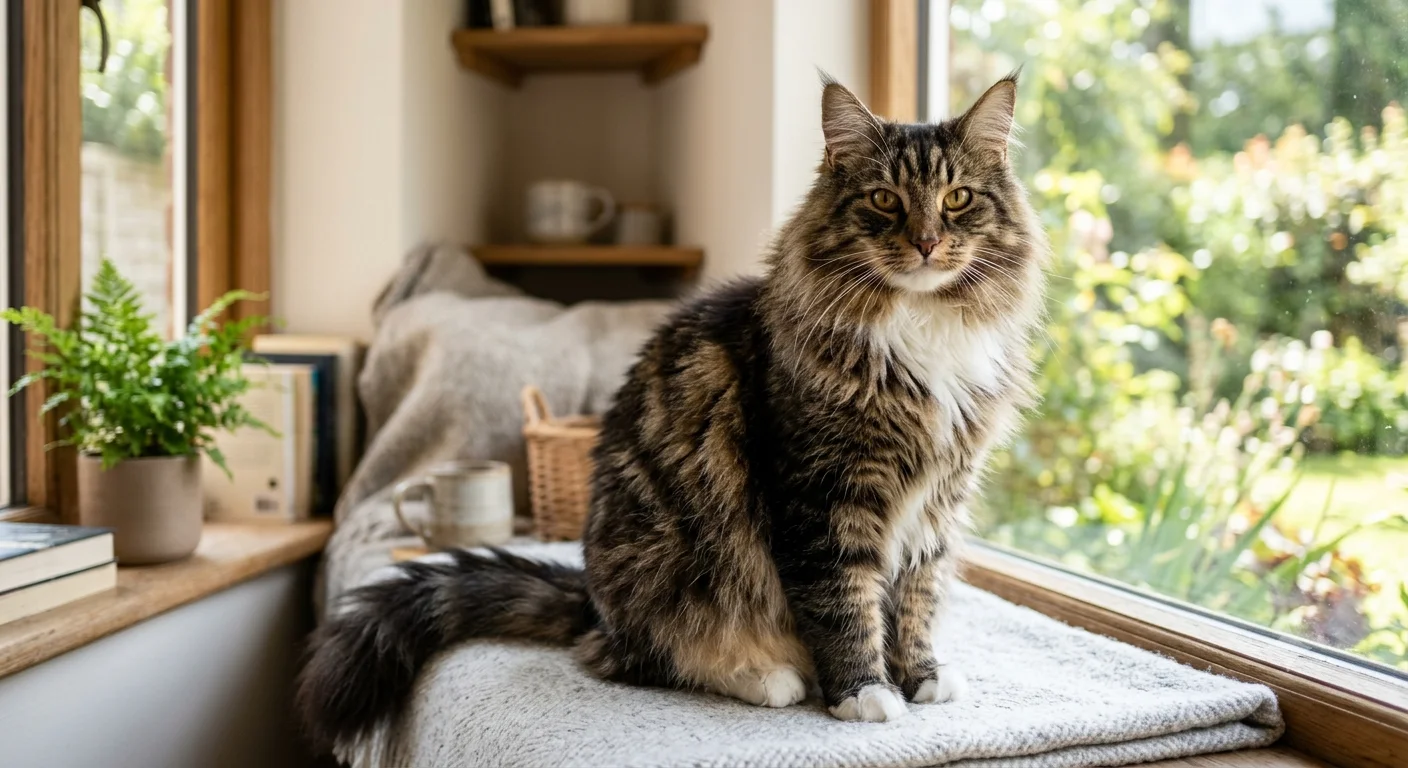
If you’ve ever watched a Norwegian Forest Cat calmly survey a room from the top of a bookshelf, then pad over ten minutes later to flop against your leg, you’ve seen their personality in miniature. The Norwegian Forest Cat personality blends quiet independence with genuine affection: they’re gentle, intelligent, and playful cats who bond deeply with their families but rarely demand constant attention. Bred for Scandinavian farms and forests, they carry a self-sufficient streak alongside real warmth — making them a calm, loyal, low-drama companion for most households.
Quick Facts: Norwegian Forest Cat Personality at a Glance
| Trait | Rating / Description |
|---|---|
| Temperament | Gentle, independent, affectionate on their own terms |
| Energy Level | Moderate (bursts of play, long stretches of calm) |
| Intelligence | High — strong problem-solvers, quick learners |
| Affection Level | Moderate-to-high — loyal but not clingy |
| Kid Friendly | Yes — patient and tolerant with respectful children |
| Dog Friendly | Yes — especially with calm, cat-savvy dogs |
| Apartment Friendly | Moderate — better with vertical space and a window view |
| Shedding | High — seasonal “coat blow” twice a year |
| Life Expectancy | 12–16 years |
| Weight | 9–20 lbs (males typically larger) |
| Size | Large — one of the biggest domestic cat breeds |
Table of Contents
- What Is the Norwegian Forest Cat Personality?
- Top Norwegian Forest Cat Personality Traits
- Norwegian Forest Cat Temperament
- Norwegian Forest Cat Characteristics
- Norwegian Forest Cat Behavior
- Are Norwegian Forest Cats Friendly?
- Are Norwegian Forest Cats Good Family Pets?
- Are Norwegian Forest Cats Good With Kids?
- Are Norwegian Forest Cats Good With Dogs?
- Can Norwegian Forest Cats Live Alone?
- Pros and Cons
- Norwegian Forest Cat vs Maine Coon Personality
- Who Should Own a Norwegian Forest Cat?
- Frequently Asked Questions

What Is the Norwegian Forest Cat Personality?
The Norwegian Forest Cat — often called a “Wegie” by fans of the breed — didn’t develop its personality in a show ring. It developed on Norwegian farms, in barns, and in forests, where the cats earned their keep hunting rodents and survived harsh winters largely on their own initiative. That history is still visible in how they act today.
Unlike breeds developed purely for companionship or appearance, the Wegie’s temperament is a working cat’s temperament, softened over generations of indoor life. They are self-reliant enough to entertain themselves for hours, but social enough to seek out their favorite humans when the mood strikes. This combination — independence paired with real affection — is the single most defining feature of the Norwegian Forest Cat personality.
Ask any long-time owner what surprised them most, and you’ll usually hear some version of the same thing: “I expected an aloof cat. I got a shadow with opinions.” They follow you room to room, but they won’t beg for laps. They love to be near you more than they love to be held.
Top Norwegian Forest Cat Personality Traits
Gentle
Norwegian Forest Cats have a soft-spoken, unhurried way of moving through a house. Despite their size — males can reach 16–20 pounds — they rarely play rough or use claws carelessly, even during boisterous play. Breeders and veterinarians frequently describe the breed’s temperament as “gentle giant” energy, similar in spirit to a large, easygoing dog breed. This gentleness is part of why the breed does well in homes with children and other pets: their size is imposing, but their behavior isn’t.
Independent
This is a cat that can be left alone with a puzzle feeder and a sunny windowsill and be perfectly content for a full workday. Independence in Norwegian Forest Cats isn’t standoffishness — it’s confidence. They don’t need constant reassurance from their owners, and they’re comfortable making their own decisions about when to nap, hunt toys, or climb. This trait traces directly back to their working history: farm cats that needed constant supervision didn’t survive Norwegian winters.
Intelligent
Owners consistently rank the Norwegian Forest Cat among the smartest cat breeds, and it shows in practical ways: they learn to open cabinet doors, figure out lever-handle doorknobs, and quickly associate specific sounds (a treat bag, a can opener) with rewards. This intelligence means they need mental stimulation — a bored Wegie will find its own entertainment, and that entertainment isn’t always what you’d choose for them.
Affectionate
Despite their independent streak, Norwegian Forest Cats form strong attachments to their families. Affection in this breed tends to look like proximity rather than lap-sitting: they’ll choose the chair next to you over the one across the room, sleep at the foot of the bed rather than demanding to be under the covers, and greet you at the door without theatrics. It’s a quieter, steadier kind of affection than you’d get from a more demonstrative breed.
Playful
Their play style reflects their hunting background. Rather than frantic zoomies, Wegies tend to prefer stalking, pouncing, and “fishing” games — toys on a string or wand toys that mimic prey movement are usually a bigger hit than a laser pointer alone. Play sessions tend to come in focused bursts rather than constant activity, which fits their overall moderate energy level.
Curious
Cabinets, boxes, grocery bags, closets — if it’s new or newly opened, a Norwegian Forest Cat will investigate it. This curiosity is closely tied to their intelligence and their climbing instinct; they want to see the room from every angle and know what’s behind every door. Owners should expect to cat-proof cabinets more thoroughly than they might with other breeds.
Loyal
Wegies tend to bond most closely with one or two people in a household, though they’re generally friendly to everyone. That loyalty shows up as habit: following a favorite person’s routine, waiting by a specific door at a specific time, or choosing one person’s lap over another’s even when both are available. It’s a quiet, consistent form of loyalty rather than an anxious one.
Calm
For a large, athletic breed, Norwegian Forest Cats are notably even-tempered. They tend not to startle easily, adjust well to new visitors, and rarely resort to hissing or aggression when uncomfortable — more often, they’ll simply remove themselves from the situation. This calm baseline is one reason the breed does well in busier, noisier households than some more high-strung breeds could tolerate.
READ ARTCILE ON :Norwegian Forest Cat Lifespan
Norwegian Forest Cat Temperament
Temperament is about how a cat responds to the world around it — its people, other animals, and new situations. Here’s how Norwegian Forest Cats typically behave across the relationships that matter most in a real household.
With Children
Norwegian Forest Cats generally do well with kids who understand basic pet boundaries. Their patience and physical sturdiness mean they can tolerate the occasional clumsy hug or overly enthusiastic petting session better than a more delicate breed might. That said, they’re not a breed that seeks out rough play, and they’ll retreat to a high perch rather than tolerate being chased or cornered — which is actually a useful trait, since it gives kids a clear, non-aggressive signal to back off.
With Families
In a multi-person household, Wegies tend to distribute their attention rather than fixate on one person exclusively, though they usually do have a favorite. They adapt well to a family’s rhythm — quiet during work hours, more social in the evening — and they’re generally easygoing about changes in routine, which makes them a good fit for busier households.
With Dogs
This is genuinely one of the breed’s strong suits. Their calm baseline and lack of skittishness mean they’re less likely to trigger a dog’s chase instinct through panicked fleeing, and their size means they’re not as physically vulnerable as a smaller cat breed might be. Slow, supervised introductions still matter, but Norwegian Forest Cats adapt to dog-friendly households more readily than many breeds.
With Other Cats
Wegies are generally sociable with other cats, particularly if raised together or introduced gradually. Their independence means they’re not needy for feline companionship, but they’re rarely hostile toward a resident cat either — expect a period of mutual assessment followed by, at minimum, peaceful coexistence, and often genuine companionship.
With Strangers
New people in the house are met with curiosity more than fear in most well-socialized Wegies. They may observe from a distance before approaching, but outright hiding or hissing at guests is less common in this breed than in more reserved ones.
With Their Owners
The bond a Norwegian Forest Cat forms with its primary owner tends to deepen over time rather than arrive immediately. Trust is earned gradually, and once it’s established, these cats become genuinely devoted — following you around the house, “helping” with tasks, and checking in periodically throughout the day, even if they’re not asking to be picked up while doing it.
Norwegian Forest Cat Characteristics
Physical
Norwegian Forest Cats are built for cold climates and physical work: a long, muscular body, a water-resistant double coat, tufted paws that act like natural snowshoes, and lynx-like ear tufts. Males typically weigh 13–20 pounds and females 9–13 pounds, with a body that takes up to five years to reach full maturity — longer than most breeds. For more detail on growth patterns and adult size expectations, see our guide to Norwegian Forest Cat size.
Mental
Their intelligence shows up as strong spatial reasoning (expert climbers and jumpers), good memory for routines and locations, and an aptitude for learning simple commands or tricks if an owner puts in consistent effort. This mental sharpness is part of why food puzzles and interactive toys matter more for this breed than for a less cognitively driven cat.
Behavioral
Expect a cat that self-regulates well: normal sleep-wake cycles, moderate vocalization, and a tendency to solve problems (open doors, retrieve toys from under furniture) rather than sit and wait for help. Behavioral issues in this breed are more often a symptom of under-stimulation than of an inherently difficult temperament.
Social
Socially, Wegies sit in the middle ground between the aloof independence of some breeds and the constant-companion nature of others. They want company, but on flexible terms — which makes them well-suited to owners who appreciate a pet’s presence without needing constant interaction.
Norwegian Forest Cat Behavior
Climbing
This is arguably the single most breed-defining behavior. Norwegian Forest Cats are natural climbers, descended from cats that scaled trees to escape predators and survey territory. A tall cat tree isn’t optional enthusiasm — it’s close to a behavioral requirement. Without vertical space, owners often find their Wegie has simply appointed the kitchen cabinets or bookshelf as a substitute.

Playing
Play tends to be purposeful rather than frantic — stalking a toy, waiting, then pouncing, much like real hunting behavior. Interactive wand toys, puzzle feeders, and toys that can be “caught” and carried around tend to hold their interest longer than toys that require no strategy.
Sleeping
Adult Wegies typically sleep in the same general range as most cats (roughly 12–16 hours a day), often choosing high, warm, or enclosed spots. Because of their thick coat, they may also seek out cooler surfaces like tile floors during warmer months.
Scratching
Scratching is a natural, necessary behavior for this breed tied to claw maintenance and territory marking, not misbehavior. Given their strength, a flimsy cardboard scratcher usually won’t last — a sturdy, tall scratching post (ideally near their favorite climbing spot) heads off scratched furniture before it starts.
Hunting Instinct
Even generations removed from farm life, the hunting drive remains strong. Many owners report their Wegie “hunting” toys, insects, or even shadows with real focus. This instinct is worth channeling into regular play rather than suppressing, since an unmet hunting drive often redirects into less convenient targets — like ankles.
Communication
Norwegian Forest Cats are moderate communicators — not silent, not constantly vocal. Expect soft chirps and trills more often than loud meows, along with expressive body language: a raised tail typically signals contentment, while a stiff, low posture signals alertness or unease.
Daily Routine
Most Wegies settle into a predictable daily rhythm fairly quickly: active in early morning and evening, calmer through midday, and consistent about mealtimes. They tend to notice and adapt to their owner’s schedule, greeting people at the door around the usual arrival time and settling in for the night on cue.
Read Article on : Norwegian Forest Cat Cost
Are Norwegian Forest Cats Friendly?
Yes, with a caveat: friendly on their own terms. Norwegian Forest Cats aren’t the type to climb into a stranger’s lap five minutes after meeting them, but they’re rarely hostile or fearful either. Most will approach new people with curiosity once they’ve had a moment to assess the situation, and they warm up considerably faster to people who let them set the pace rather than reaching for them immediately.

Are Norwegian Forest Cats Good Family Pets?
Generally, yes. Their calm temperament, tolerance for household activity, and adaptability to a family’s routine make them a solid match for most households, including ones with kids, other pets, or frequent guests. The main consideration isn’t temperament — it’s space and grooming: this is a large, long-haired breed that needs vertical climbing space and regular brushing, which matters more in a small apartment than in a house.
Are Norwegian Forest Cats Good With Kids?
Yes, particularly with children old enough to understand gentle handling. Their patience, physical sturdiness, and tendency to retreat rather than react defensively make them a low-risk breed around kids. As with any cat, supervision with very young children and teaching kids to read a cat’s body language (tail flicking, ears back) will prevent the rare bad interaction.
Are Norwegian Forest Cats Good With Dogs?
Yes, often surprisingly so. Their unflappable temperament means they’re less likely to bolt in a way that triggers a dog’s prey drive, and their size gives them enough confidence to hold their ground if needed. Success still depends heavily on the individual dog’s temperament and a proper, gradual introduction — but as far as cat breeds go, Wegies are among the more dog-tolerant.
Can Norwegian Forest Cats Live Alone?
Better than most breeds, but not indefinitely and not without preparation. Their independence means a Norwegian Forest Cat can comfortably handle a standard workday alone, especially with climbing space, a window view, and a few engaging toys. However, they still form real attachments and do best with daily interaction when their owner is home — this isn’t a breed suited to being left alone for extended stretches (multiple days) without a sitter or companion animal.
Pros and Cons
| Pros | Cons |
|---|---|
| Gentle, low-aggression temperament | Heavy seasonal shedding |
| Good with kids, dogs, and other cats | Needs significant vertical climbing space |
| Highly intelligent and trainable | Slow to mature (up to 5 years) |
| Comfortable with alone time during the day | Requires regular grooming (2–3x weekly) |
| Calm, adaptable to busy households | Large size means more food and litter costs |
| Loyal, low-drama affection | Can be destructive if under-stimulated |
Norwegian Forest Cat vs Maine Coon Personality
These two large, long-haired breeds are frequently confused, and their personalities do overlap — but they’re not identical.
| Trait | Norwegian Forest Cat | Maine Coon |
|---|---|---|
| Affection Style | Loyal, proximity-based, less demonstrative | Often more overtly affectionate and “dog-like” |
| Independence | Higher — very comfortable alone | Moderate — tends to seek more interaction |
| Vocalization | Soft chirps and trills, quieter overall | More vocal, known for chirps and trills too, but often chattier |
| Climbing Drive | Very high — bred for tree-climbing | High, but slightly less climbing-focused |
| Energy Level | Moderate | Moderate to high |
| Sociability with Strangers | Curious, cautious-then-friendly | Typically outgoing and quick to approach |
In short: if you want a slightly more independent, quieter cat with an intense climbing habit, the Wegie usually fits better. If you want a more overtly social, chattier companion, a Maine Coon often edges ahead. Both share the “gentle giant” reputation and do well in family homes.
READ ARTICLE ON : Norwegian Forest Cat Size
Who Should Own a Norwegian Forest Cat?
Ideal Owners
- Households with vertical space (cat trees, shelving) or willingness to add it
- Owners comfortable with regular brushing, especially during seasonal shedding
- Families with kids or dogs who can offer calm, respectful interaction
- People who want a loyal but low-maintenance emotional companion
- Owners who can provide mental stimulation (puzzle feeders, interactive play)
- Households where the cat will have company for at least part of most days
Not Ideal Owners
- Owners wanting a constantly cuddly, lap-dwelling cat
- Very small apartments with no room for climbing structures
- People unable to commit to regular grooming
- Owners who will be away for extended multi-day stretches without a sitter
- Households wanting a low-shedding breed
Frequently Asked Questions
Are Norwegian Forest Cats affectionate?
Yes, but in a quieter, proximity-based way rather than constant lap-sitting or cuddling. They show affection through following their owners around and choosing to be nearby.
Are Norwegian Forest Cats vocal?
No, they’re generally quiet, using soft chirps and trills rather than frequent loud meowing.
Do Norwegian Forest Cats like to be held?
Not typically. Most prefer sitting beside their owner over being picked up or restrained, though individual cats vary.
Are Norwegian Forest Cats hypoallergenic?
No. Despite some myths around long-haired breeds, no cat breed is truly hypoallergenic, and the Wegie’s heavy shedding coat produces a normal amount of dander.
Do Norwegian Forest Cats get along with other pets?
Generally yes, including dogs and other cats, especially with gradual introductions.
How much exercise do Norwegian Forest Cats need?
Moderate daily play, ideally two short sessions with interactive toys, plus access to climbing space for self-directed exercise.
Are Norwegian Forest Cats easy to train?
Relatively, yes. Their intelligence makes them responsive to clicker training, simple commands, and litter box training compared to many breeds.
Do Norwegian Forest Cats have separation anxiety?
Rarely. Their independent nature generally makes them tolerant of being alone during the day, though long-term isolation isn’t recommended.
Why do Norwegian Forest Cats like high places?
It’s an instinct carried over from their wild ancestry, when height offered safety from predators and a good vantage point for hunting.
Are Norwegian Forest Cats good for first-time cat owners?
Yes, generally. Their calm, adaptable temperament and moderate care needs (aside from grooming) make them manageable for owners new to cats, provided they’re prepared for the coat maintenance and climbing space requirements.
Do Norwegian Forest Cats shed a lot?
Yes — heavily during seasonal coat blows in spring and fall, with lighter shedding year-round. Regular brushing (2–3 times weekly, daily during coat blow) keeps it manageable. Our guide to Norwegian Forest Cat grooming covers seasonal coat care in more depth.
How big do Norwegian Forest Cats get?
They’re one of the larger domestic breeds, with males often reaching 13–20 pounds and a body that keeps developing until around age five.
Final Thoughts: Is the Norwegian Forest Cat Personality Right for You?
The Norwegian Forest Cat personality rewards owners who appreciate a pet’s company without needing constant validation from it. They’re gentle enough for kids, calm enough for dogs, smart enough to keep you on your toes, and independent enough to handle a workday alone — but they still choose you, quietly and consistently, in a way that builds into real loyalty over time.
Key takeaways:
- Gentle, intelligent, and independent — a low-drama, high-loyalty companion
- Good fit for families, kids, and dog-friendly households
- Needs vertical climbing space and regular grooming to thrive
- Comfortable alone during the day, but not for extended stretches
- Distinct from, but often confused with, the Maine Coon
If this temperament matches what you’re looking for, it’s worth exploring related practical questions before bringing one home — including Norwegian Forest Cat cost, Norwegian Forest Cat diet needs for their large size, the range of Norwegian Forest Cat colors recognized by breed standards, typical Norwegian Forest Cat lifespan and health considerations, and what to expect when raising Norwegian Forest Cat kittens through their unusually slow, multi-year maturity.
4 Comments
[…] Vet Advice: Every commercial cat food sold in the U.S. should carry an AAFCO (Association of American Feed Control Officials) statement confirming it’s “complete and balanced” for a specific life stage. Always check the label before buying.READ ARTICLE ON :Norwegian Forest Cat Personality […]
[…] READ ARTICLE ON : Norwegian Forest Cat Personality […]
[…] READ ARTICLE ON : Norwegian Forest Cat Personality: The Complete Guide to Traits, Temperament, and Behavior […]
[…] Callout — Slow-Maturing Breed: Norwegian Forest Cats are one of several breeds (alongside Maine Coons and Siberians) that don’t finish growing until 4–5 years old. Don’t be surprised if your cat is still visibly changing in shape and coat well past its first birthday.READ Article on : Norwegian Forest Cat Personality […]